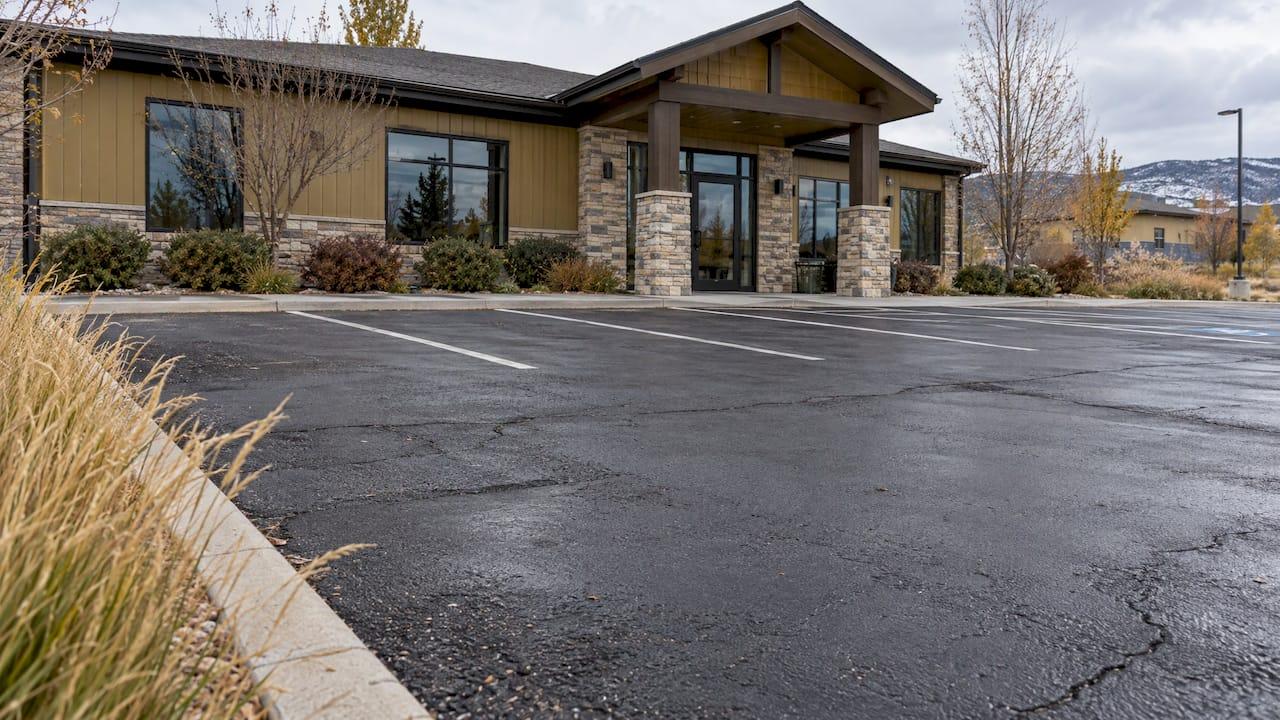
Land itself is never depreciable, but most things you build on it for your business are. Parking areas, fences, paved drives, landscaping tied to a building and similar site work are land improvements. They generally fall in the 15-year MACRS class, and for qualified property placed in service after January 19, 2025, they can qualify for 100% bonus depreciation. At The Tax Refinery, we help business owners and real estate investors sort each project cost into the right bucket, because that sorting decides whether you deduct the cost now or over many years.
TL;DR
- Land is never depreciable. Land improvements with a determinable useful life are, usually as 15-year MACRS property (Asset Class 00.3), not 5-year property.
- Because the recovery period is 20 years or less, land improvements can qualify for 100% bonus depreciation for qualified property placed in service after January 19, 2025.
- Repairs and maintenance are deducted now. Betterments, restorations and adaptations are capitalized and depreciated.
- The de minimis safe harbor lets you expense items up to $2,500 per invoice or item ($5,000 with an applicable financial statement). It excludes land. The small taxpayer safe harbor covers eligible buildings, not land improvements.
- When you buy land and buildings together, allocate the price between them. Keep records that separate site work from structures.
Table of Contents
- Why land is not depreciable but improvements are
- What counts as a land improvement
- Are land improvements depreciated over 5 years?
- Bonus depreciation changes the math
- Repair or improvement? Expense versus capitalize
- The safe harbors: what they cover and what they do not
- Buying land and buildings together
- Records that protect the deduction
- Our perspective
- Plan the project before you pay for it
- FAQ
- Sources
Why land is not depreciable but improvements are
Depreciation recovers the cost of property that wears out. IRS Publication 946 explains that land never wears out, so it is never depreciable. Costs of getting land ready for a specific depreciable asset, such as grading for a building, can be tied to that asset and depreciated with it.
Plain land costs stay in your basis (your cost in the property) until you sell. IRS Publication 527 says that for residential rental property, the costs of clearing, grading, planting and landscaping are usually part of the cost of the land and cannot be depreciated.
So the working question is never "is it on the land?" Everything is on the land. The question is whether the asset has a determinable useful life.
The five tests for depreciable property
IRS Topic No. 704 lists what property must meet:
- You own it.
- You use it in a business or income-producing activity.
- It has a determinable useful life.
- It is expected to last more than one year.
- It is not excepted property.
A paved parking lot behind your clinic or your commercial cleaning shop passes all five. The dirt underneath it does not. That split is the heart of this topic.
What counts as a land improvement
Publication 946 lists swimming pools, paved parking areas, wharves, docks, bridges and fences as land improvements. Tax professionals commonly add sidewalks, irrigation systems, retaining walls, outdoor lighting and ground-mounted signs to the same group, since they are permanent site features that are not buildings.
The tax definition excludes buildings. Wolters Kluwer's cost segregation guidance describes how courts decide the edge cases: an inherent permanency test and an appearance and function test, both borrowed from investment tax credit rules. Structural components added to an existing building are treated as additions to the building and use its recovery period.
Quick sorting table
| Item | Usual tax treatment | Recovery period |
|---|---|---|
| Bare land, purchase price | Not depreciable | None, stays in basis |
| Clearing, grading, planting, landscaping not tied to a depreciable asset | Part of land cost | None |
| Paved parking, fences, sidewalks, pools, bridges, docks | Land improvement | 15 years |
| Building structure, residential rental | Building | 27.5 years |
| Building structure, nonresidential | Building | 39 years |
| Ongoing mowing, pruning, fertilizing | Deductible operating expense | Current year |
The 27.5-year and 39-year periods for buildings are described in the Wolters Kluwer material above. The 15-year land improvement period comes from Revenue Procedure 87-56, Asset Class 00.3, as discussed in a University of Chicago Law Review essay.
Are land improvements depreciated over 5 years?
No. This is a common search because 5-year property is the class most people associate with equipment and vehicles. Land improvements are 15-year property under Asset Class 00.3, and 15 years is the general depreciation system recovery period. Putting site work in the 5-year class is a misclassification, and it can create problems if the return is examined.

The most common mistake runs the other way: a project coded to the building (39 years) when much of it was actually site work (15 years). That error costs you deductions for decades.
Bonus depreciation changes the math
Bonus depreciation requires property with a MACRS recovery period of 20 years or less. The University of Chicago essay notes that land improvements meet this test and buildings do not. For qualified property placed in service after January 19, 2025, 100% bonus depreciation applies under the One Big Beautiful Bill Act.
The essay makes the key point for owners: with permanent 100% bonus depreciation, each dollar correctly allocated to a 15-year land improvement class can produce an immediate deduction, while a dollar misallocated to a longer class is deferred for decades.
A worked example
Say your S corporation owns its shop and spends $120,000 on a new paved lot, perimeter fencing and exterior lighting in one year. Assume a combined 35% federal and state marginal rate for illustration only.
- Treated as 15-year property with bonus depreciation: the full $120,000 can be deducted in the year it is placed in service, worth about $42,000 in tax at the assumed rate.
- Spread over 15 years without bonus: the first-year deduction is only a small fraction of the cost, and recovery drags on through the following decade and a half.
- Wrongly lumped into the 39-year building: no bonus depreciation, and an annual deduction of a few thousand dollars.
The same dollars, the same project, and a very different cash outcome depending on classification. Bonus depreciation is not mandatory, so you can also elect out of it for a class of property when a deduction now does not fit your income picture. Our guides on bonus depreciation in 2026 and Section 179 versus bonus depreciation walk through that choice.
Gray areas: utility lines and site infrastructure
Not everything sorts cleanly. The University of Chicago essay points out that a water line running from the street to a building is not defined by the tax code as either site infrastructure or building plumbing. On-site utility lines that connect to a building remain a gray area, and cost segregation analysis (an engineering-based study that splits a property's cost into recovery classes) is typically used to resolve them. For owners of rental property, our piece on cost segregation for rental owners explains how that works with 100% bonus.
For a smaller project, a documented, reasonable allocation supported by invoices that describe the work separately is the foundation of any position you take.
Repair or improvement? Expense versus capitalize
The second half of the keyword is the expense-versus-capitalize decision. Publication 946 defines an improvement as an addition to, or partial replacement of, property that is a betterment, restores the property, or adapts it to a new or different use. Improvements are treated as separate depreciable property. Ordinary repairs are deducted as business expenses.
The IRS's own example: patching a small section of roof is a deductible repair, while replacing the entire roof is a restoration that must be depreciated.
Applied to site work:
- Deduct now: filling potholes, sealcoating, repairing a few fence panels, mowing, pruning and fertilizing, and replacing a broken irrigation head.
- Capitalize: paving a new lot, replacing an entire fence run, installing an irrigation system, building a retaining wall, or converting a lawn into a parking area.
The IRS summarizes the dividing line on its tangible property regulations page: costs that better, restore or adapt a unit of property are generally capitalized, and other costs are generally deductible as repairs and maintenance. When a project mixes both, ask your contractor to itemize the invoice. A lump-sum line reading "site work" invites a poor allocation.
Landscaping deserves its own warning. Landscaping that is a permanent part of a depreciable project may be treated differently from landscaping that is simply part of the land. If you run a landscaping company, our landscaping business tax guide covers the operating side.
The safe harbors: what they cover and what they do not
Safe harbors are elections that let you skip the capitalization analysis in defined situations. Two get searched alongside land improvements, and both have limits that matter here.
De minimis safe harbor
The IRS page above states that the de minimis safe harbor lets you deduct amounts up to $5,000 per invoice or item if you have an applicable financial statement (generally an audited financial statement), or $2,500 per invoice or item if you do not. It excludes amounts paid for inventory and land. A $1,800 section of replacement fencing might fit under it. A $90,000 paving project does not. Our de minimis safe harbor guide covers the election and its paperwork.
Small taxpayer safe harbor
The small taxpayer safe harbor sits in 26 CFR § 1.263(a)-3(h). A taxpayer with average annual gross receipts of $10 million or less may elect not to capitalize repairs, maintenance and improvements on eligible building property with an unadjusted basis of $1,000,000 or less. The total paid during the year for that building cannot exceed the lesser of 2% of the building's unadjusted basis or $10,000.
Two points follow for this topic. First, it applies to building property, so it is not a tool for expensing a parking lot or fence. Second, it is an annual election: you attach a statement titled "Section 1.263(a)-3(h) Safe Harbor Election for Small Taxpayers" to a timely filed original return, including extensions. It is not a change in accounting method, so Form 3115 is not required.
If you have already been capitalizing and depreciating items in the wrong class, correcting it is usually a method change. Our guide to the Section 481(a) adjustment explains how the catch-up works.

Buying land and buildings together
Most owners meet this issue at purchase, not at construction. IRS Publication 551 says that if you buy buildings and the land they stand on for a lump sum, you must allocate the basis between the land and the buildings so you can figure the depreciation allowed on the buildings.
A sensible allocation uses a documented basis: the county assessor's land-to-building ratio, an appraisal, or both. Then identify which part of the "building" value is actually site work, since those items belong in the 15-year class. If you track rental properties yourself, a tool to budget rental maintenance costs also helps keep repairs separated from capital projects from the start.
When you rent your space rather than own it, Publication 946 notes that you can depreciate permanent improvements you make to business property you rent from someone else. How a landlord's allowance shapes those costs is covered in a guide on tenant improvement allowance planning.
Records that protect the deduction
Classification is only as strong as the paper behind it. Keep:
- The closing statement and allocation worksheet for any land purchase.
- Itemized contractor invoices that separate paving, fencing, lighting, utilities and building work.
- The date each asset was placed in service, since that drives bonus eligibility and the first year of depreciation.
- A short memo describing why an item is a repair or an improvement.
- Photos before and after, which help show that work restored or bettered the property.
These costs are rarely large individually, but they add up for owners with several entities. If a property is held in one entity and operated by another, the records should show which entity owns each asset and uses it in its business, since both ownership and business use are requirements for depreciation.
Our perspective
Most of the land improvement mistakes we see in this topic are not about the rules. They are about timing. The paving, the fencing and the new lighting are paid for in one season, and nobody decides how they will be classified until the return is prepared months later.
Under permanent 100% bonus depreciation, classification decides whether a $100,000 project becomes a deduction this year or a slow trickle of deductions over many years. That is a planning decision, and it belongs before the work starts, alongside your entity structure, your income level and your cash needs.
This is the reason we build tax strategy year-round for business owners, real estate investors and multi-entity operators rather than only preparing a return after the fact. Our approach is custom-built to each client's situation, with implementation, so the decision on a land improvement is made with the full picture in view.
Melissa
Plan the project before you pay for it
If you are about to pave, fence or develop a site, the best time to decide classification, bonus depreciation and entity ownership is before the first invoice. The Tax Refinery is a tax strategy and advisory firm in the Treasure Valley, Idaho, founded by Enrolled Agent Melissa Korber, and we work with business owners, real estate investors and multi-entity operators on real estate and depreciation strategy.

Our Quarterly Tax Strategy Sessions are $9,497 per year, and Monthly Tax Advisory is $11,997 per year. If you own a rental, our return for an investor or rental owner is $550, listed on the fee schedule. S corporation owners can start with the S-Corp Tax Strategy Accelerator at $997.
FAQ
Can land improvements be depreciated?
Yes, but the land itself cannot. Improvements such as paved parking, fences, sidewalks and pools have a determinable useful life, so they can be depreciated if you own them and use them in a business or income-producing activity. They generally use a 15-year recovery period.
Do land improvements qualify for bonus depreciation?
Generally yes. Bonus depreciation requires a recovery period of 20 years or less, and land improvements are 15-year property. For qualified property placed in service after January 19, 2025, 100% bonus depreciation is available, and you can elect out of it if a smaller deduction fits your situation better.
Can I use the small taxpayer safe harbor for a parking lot or fence?
No. That safe harbor covers repairs, maintenance and improvements on eligible building property of $1,000,000 or less in basis. Small items may fit the de minimis safe harbor at $2,500 or $5,000 per invoice or item, depending on whether you have an applicable financial statement. Larger site work is capitalized and depreciated.
How do I know whether a cost is a repair or an improvement?
Ask whether the work betters the property, restores it, or adapts it to a new use. If it does, capitalize it. Patching a small section is a repair, while replacing the whole fence run or paving a new lot is an improvement. Itemized invoices make the call easier to document.
Sources
- IRS Publication 946, How To Depreciate Property
- IRS Topic No. 704, Depreciation
- IRS Publication 527, Residential Rental Property
- IRS Publication 551, Basis of Assets
- IRS, Tangible property final regulations
- 26 CFR § 1.263(a)-3, Amounts paid to improve tangible property
- University of Chicago Law Review Online, essay on site work and bonus depreciation (2/22/26)
- Wolters Kluwer, Tax Benefits of Cost Segregation