
An arm's-length intercompany loan interest rate is whatever an unrelated lender would charge the borrower under the same terms, backed by Treas. Reg. §1.482-2, Applicable Federal Rate benchmarks, and comparable market data. Before you pick a number, classify the advance as debt or equity, since that decision drives everything else — the rate, the documentation, and your exposure if the IRS disagrees.
TL;DR:
- Setting an arm's-length interest rate requires confirming the loan is genuine debt and considering factors like maturity, security, and creditworthiness.
- Multiple guidance sources, including IRS regulations, AFR, and OECD principles, strengthen the defensibility of the chosen rate, especially for material loans.
- Proper documentation must include a signed agreement, proof of funds transfer, repayment history, and a detailed comparison of applicable rates and adjustments.
- Avoid common mistakes such as treating AFR as a complete transfer pricing answer or failing to reconcile loan balances with cash flow records quarterly.
- Implicit support and cross-border considerations significantly influence IRS scrutiny; ongoing review and professional advice are recommended to maintain compliance.
Table of Contents
- What Counts as Arm's-Length Interest on Intercompany Loans?
- Which Benchmarks and Guidance Govern Intercompany Financing Rates?
- How Do You Set a Defensible Arm's-Length Rate Step by Step?
- What Documentation Do You Need to Survive an Examination?
- What Mistakes Trigger Recharacterization or Rate Adjustments?
- What Are the Tax and Reporting Implications of Intercompany Interest?
- What Does an Audit-Ready Intercompany Loan File Look Like in Practice?
- Where Enforcement Pressure Is Actually Concentrated Right Now
- How a tax strategy and advisory firm supports intercompany loan documentation
- Sources
- FAQ
What Counts as Arm's-Length Interest on Intercompany Loans?
Treas. Reg. §1.482-2 defines the arm's-length rate as what an independent lender would charge, weighing loan amount, duration, security, and the borrower's creditworthiness.
Not every intra-group transfer qualifies as a loan for this purpose. Before pricing anything, you need to confirm the advance is genuine debt rather than a disguised capital contribution. Common intercompany loan types that raise this question include:
- Short-term demand loans between sister subsidiaries covering working capital gaps
- Long-term parent-to-subsidiary term loans funding capital expenditures or acquisitions
- Revolving cash-pool arrangements inside a treasury center
- Back-to-back loans routed through an intermediate holding company
Each type carries different comparability challenges, but the delineation step comes first every time. Skip it, and even a perfectly benchmarked rate won't save you from a debt-versus-equity challenge.
Which Benchmarks and Guidance Govern Intercompany Financing Rates?
Four sources anchor almost every defensible pricing position on intercompany financing rates and you'll cite some combination of them in any file that survives scrutiny.
- 26 CFR §1.482-2 lists the arm's-length factors examiners expect you to weigh: principal amount, duration, security, the borrower's credit standing, and prevailing interest rates for comparable loans.
- Applicable Federal Rates (AFR), published monthly by the IRS, come in short-term, mid-term, and long-term tiers and can serve as a safe-haven reference in specific contexts.
- IRS AM-2023-008 addresses implicit support: the Service may factor in group membership when pricing a loan if an independent lender would do the same, which means you have to test realistic third-party alternatives rather than assume a bare standalone rating.
- OECD Transfer Pricing Guidance on Financial Transactions (BEPS Actions 4, 8 to 10) spells out the comparability factors that matter most: currency, maturity, collateral, subordination, and borrower credit rating.
Quick fact: AFR is a statutory reference point, not a substitute for a full transfer-pricing conclusion. The IRS itself frames AFR as a safe-haven tool in limited circumstances, not a blanket stand-in for market comparables, so leaning on it alone leaves a gap examiners will notice.
Where these four sources overlap is where your rate gets strong. Where you only have one of them, expect questions.
How Do You Set a Defensible Arm's-Length Rate Step by Step?
Pricing an intercompany loan interest rate isn't a single calculation. It's a sequence and skipping steps is exactly where files fall apart under examination.
- Delineate the transaction. Confirm what was actually agreed to, not just what the ledger says.
- Test debt versus equity. Look for a maturity date, a fixed repayment schedule, and consistent cash-paid interest, not just accrued journal entries.
- Run a dual credit analysis. Build a standalone credit rating for the borrower as if it had no group support, then a second rating that reflects realistic implicit support, per the approach AM-2023-008 describes.
- Search for comparables. Pull data from bond and loan databases, syndicated loan pricing services, or published credit spreads for issuers with a similar rating tier.
- Adjust for material differences. Maturity mismatches, currency, collateral, subordination, guarantees, and covenant packages all move the rate and need explicit adjustment, consistent with OECD guidance on financial transactions.
- Select and document the rate. Write down why you picked this specific point in the comparable range, not just the range itself.
- Monitor and revisit. Rates that were arm's-length at origination can drift out of range as credit markets move.
When comparables are thin, such as for a small intercompany revolver, AFR can serve as a reasonable reference point. For anything material, dollar-denominated term debt with real credit risk, market comparables carry more weight than AFR alone.
Pro Tip: Keep both credit views on file, the standalone borrower rating and the group-influenced rating, even if you ultimately price off one of them. Examiners under AM-2023-008 want to see that you considered implicit support, not that you ignored it.
What Documentation Do You Need to Survive an Examination?
A rate with no paper trail behind it is a rate an examiner can challenge freely. The file needs to show both the legal form of the loan and the economic behavior behind it.
- Executed loan agreement with maturity date, stated rate, and repayment terms
- Board or officer approvals authorizing the loan
- Proof of funds transfer and an amortization schedule with interest calculations
- Payment history showing actual cash movement, not just accrued interest entries
- Comparable-rate search logs, raw data pulls, and a memo explaining adjustment rationale
- Credit analysis supporting both the standalone and group-influenced ratings
- Security, guarantee, and covenant terms tied to the comparables used
- Evidence of periodic review, showing the rate was reassessed as conditions changed
Practitioners generally organize this into two folders: the legal and cash-flow record, and the transfer-pricing benchmarking record. Keep them separate but cross-referenced, since an examiner will ask for both.
What Mistakes Trigger Recharacterization or Rate Adjustments?
Most intercompany loan problems trace back to a handful of recurring errors. Loans without a maturity date, without stated interest, or without any enforcement mechanism read as disguised equity rather than debt. IRS guidance on recharacterization has repeatedly flagged advances where cash behavior never matched the paper terms, no scheduled payments, no penalty for missed interest, no evidence anyone treated the note as real debt.
Circular loans, where cash moves in a loop between related entities with no independent business purpose, invite the same scrutiny. So do backdated notes drafted to justify a rate after the fact.
- Treating AFR as a complete transfer-pricing conclusion rather than a reference point
- Ignoring implicit support entirely, or trying to price it as a separate fee rather than folding it into the credit rating
- Letting accrued interest pile up on the books with no corresponding cash payment
- Failing to reconcile intercompany ledgers against the loan agreement terms
Pro Tip: Reconcile intercompany loan balances against cash records every quarter, not just at year-end. Mismatches that build up over twelve months are far harder to explain than one caught in month three.
What Are the Tax and Reporting Implications of Intercompany Interest?
Interest expense on a properly structured intercompany loan is deductible under Section 163, but that deduction can still be adjusted under Section 482 if the rate charged wasn't arm's-length. The two provisions work together: 163 asks whether interest is deductible at all, 482 asks whether the amount was priced correctly between related parties.
- Section 7872 can impute interest on below-market related-party loans, though a narrow safe harbor exists for certain shareholder loans under $10,000; above that threshold, a no-interest or low-interest loan can create phantom interest income and expense.
- Cross-border intercompany loans often trigger withholding tax obligations and treaty-based documentation requirements on the interest paid.
- Domestic related-party interest generally still requires Form 1099-INT reporting where applicable.
- Reconciliation controls, matching the accrual on the books to the cash actually paid and the amount reported to the IRS, catch most of these issues before an examiner does.
What Does an Audit-Ready Intercompany Loan File Look Like in Practice?
Picture two common setups. In the first, sister subsidiaries exchange a short-term demand loan to cover a seasonal cash gap. The file needs a signed demand note, a short comparables search against similar revolving facilities, and a payment ledger showing interest actually changed hands.
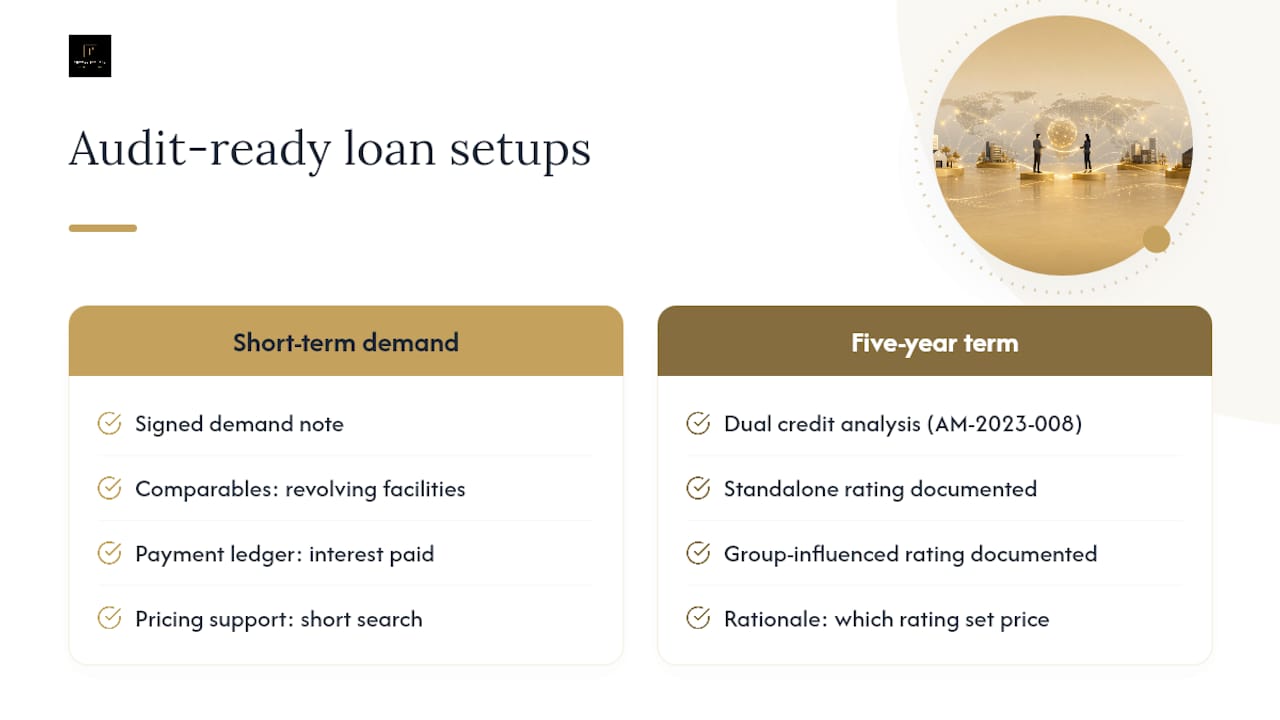
In the second, a parent funds a subsidiary's expansion with a five-year term loan, and the subsidiary likely wouldn't get the same terms standing alone. That calls for the dual credit analysis AM-2023-008 describes: a standalone rating, a group-influenced rating, and a documented rationale for which one drove the final price. Multi-entity structures with several loans running at once benefit from a standing review calendar, something an advisory engagement built around ongoing tax strategy work naturally supports rather than a once-a-year filing conversation.
Where Enforcement Pressure Is Actually Concentrated Right Now
The IRS is spending real attention on implicit support and whether taxpayers tested realistic alternatives, not just whether a number fell inside some published rate band. Get the delineation right, keep terms enforceable, keep a real payment history, and reconcile your books against the loan agreement. When a loan involves cross-border flows or a borrower with thin standalone credit, bring in transfer-pricing help before the rate gets set, not after an exam letter arrives.
— Melissa
How a tax strategy and advisory firm supports intercompany loan documentation
Certain tax advisory services give multi-entity business owners a standing advisory relationship instead of a once-a-year scramble to justify a rate after the fact. That distinction matters most when a loan sits between related entities and needs a benchmarking memo, a dual credit analysis, and a periodic review calendar, not a single spreadsheet built the week before a deadline.

An engagement built through Monthly Tax Advisory or Quarterly Tax Strategy Sessions gives multi-entity operators a structured place to revisit intercompany rates as credit markets shift, rather than discovering a stale rate during an exam. For S-Corp owners juggling shareholder loans alongside intercompany advances, the S-Corp Tax Strategy Accelerator addresses the entity-structuring questions that often surface alongside loan pricing. If your group has never built a documentation file for its intercompany loans, that's the first conversation worth having, and the tax strategy comparison page is the right place to see what an ongoing engagement actually includes.
Sources
- 26 CFR § 1.482-2 - Determination of taxable income in specific situations
- Memorandum AM-2023-008
- Transfer Pricing Guidance on Financial Transactions: Inclusive Framework on BEPS (OECD)
- Applicable Federal Rates | Internal Revenue Service
FAQ
Do You Have to Pay Interest on Intercompany Loans?
Yes, in almost every case involving related U.S. entities, since §1.482-2 requires an arm's-length rate once indebtedness arises. Ordinary-course intercompany trade receivables get a limited interest-free grace period, but genuine loans need a real, documented rate.
How Do You Account for Intercompany Loans?
Record the loan with an executed agreement, an amortization schedule, and interest accruals that match actual cash payments, not just book entries. Reconcile the intercompany ledger against the loan terms regularly so accounting records and legal terms never drift apart.
What Is Considered an Intercompany Loan?
Any advance of funds between related entities within the same multinational group, including short-term demand loans, long-term term loans, revolving cash-pool balances, and back-to-back arrangements through a holding company. Whether it's treated as debt or equity depends on formal terms, repayment history, and enforceability, not just the label on the transaction.
Can a Company Loan Money to Another Company Interest-Free?
Generally no, if the companies are related and the loan is more than a small, short-term advance, since Section 7872 can impute interest on below-market related-party loans. A narrow safe harbor exists for certain shareholder loans under $10,000, but above that threshold, an interest-free loan risks phantom interest income and a transfer-pricing adjustment under §482.