
Intercompany agreements are the legal evidence a tax examiner relies on first when testing a transfer-pricing position. Without a signed, contemporaneous agreement that matches your transfer-pricing study, you risk recharacterization of income and penalties under IRC §6662(e). If you manage multi-entity structures, check two things today: the execution date on every intercompany agreement, and whether the pricing language actually matches what your transfer-pricing study says.
TL;DR:
- Properly executed intercompany agreements should be signed, contemporaneous, and clearly reflect actual conduct, scope, and pricing method to withstand tax authority scrutiny.
- Agreements involving intangible licensing, cross-border financing, or cost-sharing arrangements attract more audit risk and require detailed documentation to justify risks and functions.
- Matching the agreement's language and execution date with actual transactions prevents costly recharacterizations and penalties under IRC §6662(e).
- Agreements must link the pricing method directly to the transfer-pricing study, specify payment terms, and include provisions for recordkeeping to ensure a tax-defensible position.
- Regular review and updating of ICAs, especially after acquisitions or tax law changes, help mitigate common audit triggers and support advance pricing arrangements or dispute resolution efforts.
Table of Contents
- What Are Intercompany Agreements and Why Do They Matter for Tax Compliance?
- What Types of Intercompany Agreements Raise the Most Tax Issues?
- What Must a Tax-Defensible Intercompany Agreement Include?
- How Does Section 482 and the Arm's-Length Standard Work?
- What Are the Most Common Audit Triggers for Intercompany Agreements?
- How Should You Draft, Execute, and Maintain Intercompany Agreements?
- How Do OECD, BEPS, and Pillar Two Affect Intercompany Agreements?
- How Does The Tax Refinery Approach ICA Reviews for Multi-Entity Clients?
- How Do Intercompany Agreements Affect Withholding Taxes on Cross-Border Payments?
- How Do Intercompany Agreements Interact With VAT and GST?
- What Role Do Intercompany Agreements Play in APAs and Dispute Resolution?
- Editorial Perspective: What Practitioners Get Wrong About ICAs
- Get Your Intercompany Agreements Audit-Ready With The Tax Refinery
- Sources
- FAQ
What Are Intercompany Agreements and Why Do They Matter for Tax Compliance?
An intercompany agreement (ICA) is a written contract between related entities within the same corporate group that documents how they price and conduct transactions with each other, whether that's a management fee, a license, a loan, or a distribution arrangement. Tax authorities treat these documents as primary evidence of intent. When a related-party transaction has no signed agreement, or the agreement doesn't match what actually happened, examiners have grounds to question the entire pricing position.
The arm's-length principle sits underneath all of this. Under Treasury Regulation 1.482-1, transactions between related entities must be priced as if the parties were unrelated, dealing at fair market terms. A well-drafted ICA is how you demonstrate, in writing, that the pricing was set deliberately and consistently, not reverse-engineered after the fact.
Tax examiners typically start a transfer-pricing review by requesting a defined set of documents. According to IRS International Practice Units, that request usually includes:
- Organizational charts showing entity relationships
- The transfer-pricing study supporting the pricing method
- Signed intercompany agreements and contracts
- Invoices and supporting books and records
- A transfer-pricing roadmap or narrative explaining the group's structure
One practical signal worth internalizing: industry guidance on transfer pricing notes that examiners often treat the ICA as the starting point for a desktop exam. A clean, aligned agreement can shorten the entire review.
What Types of Intercompany Agreements Raise the Most Tax Issues?
Not every intercompany agreement carries the same audit risk. Some categories draw far more scrutiny than others because they involve intangibles, cross-border cash flows, or subjective pricing judgments.
- IP licensing agreements raise DEMPE questions (development, enhancement, maintenance, protection, and exploitation of intangibles).. Tax authorities want to know which entity actually performs these functions, not just which entity holds legal title.
- Service and management fee agreements face the "benefit test": the recipient must show measurable value from the service, backed by deliverables like reports or time records. Low-value-adding services (LVAS) get particular attention because markups on routine support functions are an easy audit target.
- Financing and loan agreements get tested against debt-versus-equity indicators; thin capitalization, missing repayment terms, or below-market interest rates invite recharacterization as equity.
- Distributor and reseller agreements need to reflect who actually bears inventory, credit, and market risk, not just who invoices the customer.
- Cost-sharing arrangements carry a specific written-agreement requirement under 26 U.S. Code § 482; fail that requirement and the arrangement can be recharacterized entirely.
Each type has a different documentation burden, but all of them fail for the same underlying reason: the paper doesn't match the practice.
What Must a Tax-Defensible Intercompany Agreement Include?
A defensible ICA isn't a template with names swapped in. It has to survive an examiner reading it line by line against your actual books and conduct. Here's what belongs in every agreement:
- Scope language that matches conduct. Spell out deliverables, frequency, and which entities receive the benefit. Vague scope is the fastest way to lose credibility with an examiner.
- An explicit pricing method. State whether you're using CUP, CPM, TNMM, or another method, and reference the transfer-pricing study that supports it. Never leave pricing to be inferred.
- Payment, invoicing, and currency terms. Specify timing, currency, and invoicing cadence. Inconsistent or missing payment terms suggest the agreement was drafted after the fact.
- Risk allocation with financial capacity behind it. If an entity assumes risk on paper, it needs the capital and functional substance to actually bear that risk.
- Signatures and dates that precede the transactions. An unsigned or undated agreement is close to worthless as evidence.
- A recordkeeping clause. Name the supporting deliverables (time logs, invoices, benchmarking reports) and how long they're retained.
Pro Tip: Before you sign anything, walk the agreement past your actual invoices from the last two quarters. If the paper describes a service that doesn't match what's on the books, fix the agreement or fix the practice before an examiner finds the gap for you.
How Does Section 482 and the Arm's-Length Standard Work?
Section 482 gives the IRS authority to reallocate income, deductions, or credits among related entities when transactions aren't priced at arm's length. Under 26 CFR § 1.482-1, the accepted methods include the comparable uncontrolled price method (CUP), the comparable profits method (CPM), the transactional net margin method (TNMM), and the profit split method (PSM). Your intercompany agreement should name the method used and point back to the transfer-pricing study that justifies it.
Penalty exposure is steep and specific. Under IRC §6662(e), a 20% accuracy-related penalty applies to significant transfer-pricing adjustments above certain thresholds. A 40% penalty applies for gross valuation misstatements. Contemporaneous documentation, prepared by the time the return is filed, is the primary way to establish reasonable cause and avoid these penalties.
To reduce that exposure:
- Prepare or update the transfer-pricing study before the return is filed, not after an audit notice arrives.
- Cross-reference the ICA and the study explicitly, so pricing methodology isn't stated twice with different logic.
- Keep a signed copy of every ICA in the same file as the supporting study and benchmarking analysis.
Our breakdown of what §6662 penalties actually mean walks through specific adjustment scenarios if you want the mechanics in more depth.
What Are the Most Common Audit Triggers for Intercompany Agreements?
Most transfer-pricing adjustments trace back to a handful of recurring mistakes, and they're almost always avoidable with better process discipline.
- Conduct that doesn't match the contract. If the agreement says Entity A bears market risk but Entity B is the one absorbing losses in practice, the examiner will follow the money, not the paper.
- Backdated or unsigned agreements. A contract executed after the transactions it covers isn't contemporaneous documentation. It reads as an afterthought, because it is one.
- Risk parked in shell or low-substance entities. If the entity holding contractual risk has no employees, no capital, and no decision-making authority, that allocation won't survive scrutiny under OECD's accurate delineation standard.
- Bundled service fees with no objective metric. A flat management fee with no timesheets, headcount allocation, or usage data behind it is one of the easiest line items for an examiner to challenge.
- ICAs that were never reconciled with the master file or local file. When the narrative in your transfer-pricing documentation contradicts the agreement's language, both documents lose credibility.
Pro Tip: If you've grown through acquisition, pull every legacy intercompany agreement from acquired entities and check the execution date against the transaction start date. That mismatch is one of the most common findings in post-acquisition reviews.
How Should You Draft, Execute, and Maintain Intercompany Agreements?
Good ICA management is a process, not a one-time drafting exercise. Build it around these steps:
- Draft from actual operations, not a template. Start with what the entities really do, then write the agreement to match, coordinating directly with whoever prepared the transfer-pricing study.
- Execute before the fiscal period or first transaction begins. Retroactive execution undermines the entire evidentiary value of the document.
- Attach objective performance metrics. Timesheets, usage reports, or transaction counts should tie directly to the invoices generated under the agreement.
- Set a review cadence. Annual reviews catch drift between the contract and current operations before an examiner does.
- Maintain version control and a central repository. Every signed agreement, amendment, and superseding version should live in one place, accessible to whoever prepares the annual transfer-pricing study.
- Re-negotiate when the business or the tax rules change. A shift in functions, a new jurisdiction, or a Pillar Two top-up tax exposure are all valid reasons to revisit pricing terms, not just wait for the next renewal cycle.
Multi-entity owners handling related-party compensation should also review documentation standards under common paymaster rules, which face similar substantiation demands from examiners.
How Do OECD, BEPS, and Pillar Two Affect Intercompany Agreements?
The OECD Transfer Pricing Guidelines introduced the concept of accurate delineation: tax administrations look past the contract to determine which entity actually performs the functions, uses the assets, and bears the risks. For intangibles, that means a DEMPE analysis (development, enhancement, maintenance, protection, exploitation) can override what the licensing agreement states on paper if conduct tells a different story.
Action 13 of the BEPS project formalized the three-tiered documentation structure: master file, local file, and country-by-country reporting. Your ICA should feed directly into the local file, since local tax authorities frequently request a copy of the signed agreement alongside the benchmarking study when a transaction crosses a materiality threshold.
Pillar Two adds a newer wrinkle. Groups above the applicable revenue threshold now face top-up taxes designed to bring effective tax rates in low-tax jurisdictions up to a global minimum, under OECD's Pillar Two framework. That changes the economics behind agreements that were originally structured to shift profit toward lower-tax entities. If your group is in scope, existing ICAs tied to those jurisdictions deserve a fresh look, not because the pricing method is wrong, but because the tax outcome behind it has shifted.
How Does The Tax Refinery Approach ICA Reviews for Multi-Entity Clients?
A proper ICA diagnostic starts with a documentation pull: every signed agreement, the current transfer-pricing study, recent invoices, and the entity org chart. From there, the review checks three things: does the contract match actual conduct, does the pricing method tie back to the study, and is the paper trail contemporaneous rather than reconstructed after the fact.
The remediation playbook that follows typically includes redrafted scope language, updated benchmarking references, and a signed execution timeline that closes any gaps before the next filing deadline. For multi-entity operators, that review often surfaces overlooked issues, like a management fee agreement with no timesheet support, or a financing arrangement missing formal repayment terms.
The firm is led by an Enrolled Agent and focuses on proactive, year-round tax strategy rather than once-a-year filing, with attention to multi-entity structuring and S-corp planning for established business owners.
How Do Intercompany Agreements Affect Withholding Taxes on Cross-Border Payments?
Cross-border intercompany payments, royalties, interest, and service fees paid between entities in different countries frequently trigger withholding tax obligations at the source country level. The intercompany agreement is often the document a payer relies on to determine the correct withholding rate, particularly when a tax treaty reduces the statutory rate.
If the agreement misclassifies a payment, calling a royalty a service fee, for instance, the withholding treatment can be wrong from the start. Tax authorities in the payer's jurisdiction will look at the actual substance of the payment, not just its label, and an ICA that doesn't clearly define what's being paid for creates exposure on both sides of the transaction.
Treaty relief typically requires documentation showing the recipient is the beneficial owner of the income and qualifies under the treaty's limitation-on-benefits provisions. An ICA that clearly identifies the payer, the payee, the nature of the payment, and the pricing method gives both jurisdictions consistent facts to work from. Without that clarity, you risk double taxation: one country withholding tax on the gross payment while the other taxes the same income again on a net basis.
Multinational groups restructuring debt or licensing arrangements should treat withholding tax analysis as inseparable from transfer-pricing analysis. The two are calculated differently, but they draw from the same underlying contract.
How Do Intercompany Agreements Interact With VAT and GST?
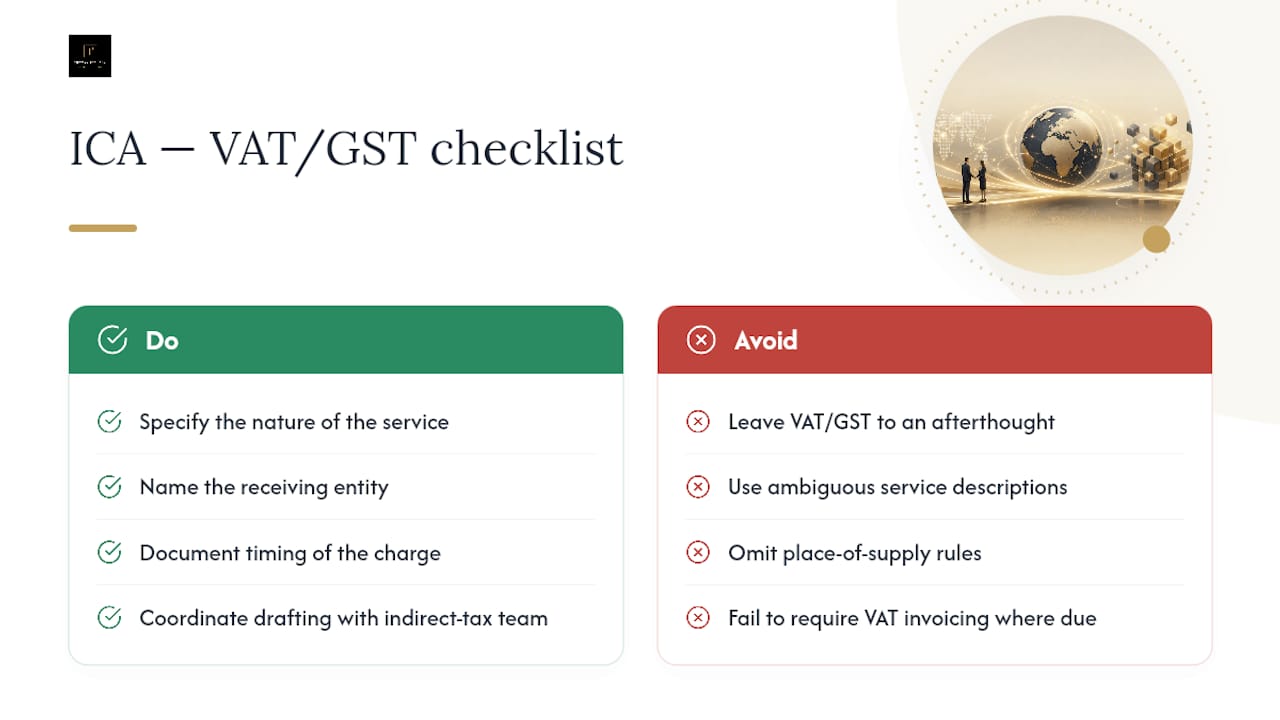
Value-added tax and goods-and-services tax regimes generally require a legal basis for classifying a transaction, whether it's a supply of services, a licensing arrangement, or a sale of goods between related entities. The intercompany agreement is usually the document VAT and GST auditors examine first to determine how a transaction should be characterized and where the tax point falls.
Management fee arrangements are a frequent friction point. Some jurisdictions treat intercompany service charges as a taxable supply requiring VAT invoicing between entities, even when the entities are consolidated for income tax purposes. If the ICA doesn't specify the nature of the service, the recipient, and the timing of the charge, the VAT treatment becomes a guessing exercise for whoever prepares the return.
Cross-border services add another layer. Many VAT and GST systems use place-of-supply rules that depend on where the recipient is located and what type of service is being provided. An ICA that clearly states the service category and the receiving entity supports the correct place-of-supply determination. Ambiguous agreements create risk of both under-collection (triggering penalties) and over-collection (creating cash-flow drag from unrecoverable input tax).
Coordinating your ICA drafting with whoever manages indirect tax compliance, rather than leaving VAT and GST as an afterthought to the income tax analysis, closes a gap that trips up plenty of multi-entity groups during expansion.
What Role Do Intercompany Agreements Play in APAs and Dispute Resolution?
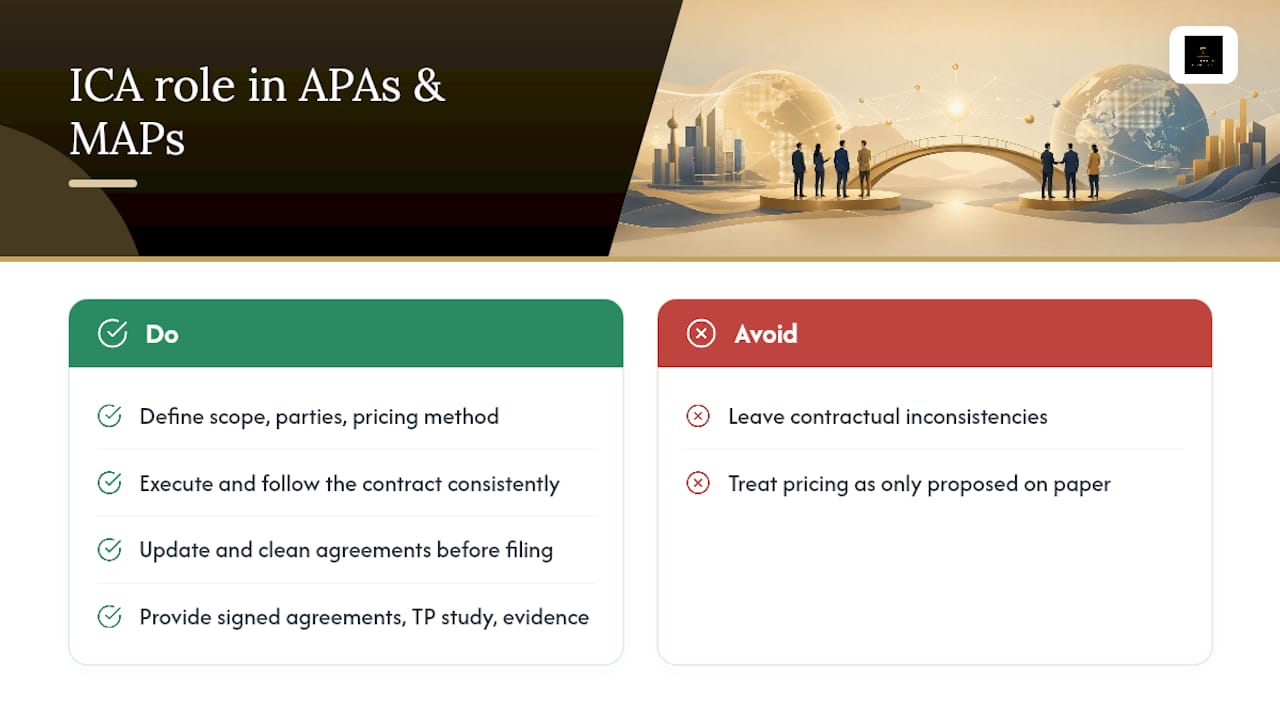
An Advance Pricing Agreement (APA) is a negotiated agreement between a taxpayer and one or more tax authorities that fixes the transfer-pricing method for covered transactions in advance, reducing audit uncertainty for a defined period. The intercompany agreement is central to that negotiation because it's the document that defines the transaction's scope, the parties involved, and the proposed pricing method the APA will formalize.
When a transfer-pricing dispute reaches mutual agreement procedure (MAP) negotiations between two countries' tax authorities, examiners on both sides will compare the ICA against actual conduct and financial results. A contract that was properly executed, consistently followed, and aligned with the transfer-pricing study gives both tax authorities a stable reference point, which tends to shorten negotiations. A contract riddled with inconsistencies gives each side room to argue for a different allocation of income.
For groups considering an APA, updating and cleaning up existing intercompany agreements before filing the application is a practical first step. Tax authorities reviewing an APA request will ask for the same documentation an examiner would in an audit: signed agreements, the transfer-pricing study, and evidence that the pricing method has actually been followed in practice, not just proposed on paper.
Editorial Perspective: What Practitioners Get Wrong About ICAs
Most transfer-pricing advice treats the intercompany agreement as paperwork, something to file away once the transfer-pricing study is complete. That's backwards. The agreement and the study have to be built together, because an examiner reading one against the other is exactly how audits get won or lost.
The bigger blind spot is timing. Plenty of well-run companies have solid transfer-pricing studies and still get hit with adjustments, because the agreement supporting the pricing was signed months after the transactions started. Contemporaneous documentation isn't a nice-to-have under IRC §6662(e); it's the difference between a 20% penalty and no penalty at all.
If you take one thing from this guide, prioritize the execution date over the pricing method. A defensible method with a late signature is still exposed. A modest method with a signed, contemporaneous agreement that matches actual conduct holds up far better under scrutiny. Fix the sequencing problem first. The pricing refinements matter, but they matter less than most practitioners assume.
— Melissa
Get Your Intercompany Agreements Audit-Ready With The Tax Refinery
Thetaxrefinery builds multi-entity tax strategy around what actually survives an audit, not a generic template pulled from a legal forms site. For business owners running related-party structures, that means intercompany agreements, entity documentation, and transfer-pricing alignment get reviewed as one connected system rather than three separate afterthoughts handled by three different advisors.

A typical engagement starts with a documentation review across your existing entities, checks agreements against actual conduct, and flags gaps before they become audit findings. Multi-entity owners often start with the S-Corp Tax Strategy Accelerator for entity-level structuring, then move into ongoing advisory support for year-round monitoring as the business grows or restructures. If you're managing multiple related entities and aren't certain your intercompany paperwork would hold up under an examiner's request, book a review and get a clear picture of where the gaps are before tax season forces the question.
This article is general information, not a substitute for advice from a qualified financial advisor. Consult a qualified financial professional about your own circumstances before acting on anything here.
Sources
- 26 CFR § 1.482-1 - Allocation of income and deductions among taxpayers
- OECD Transfer Pricing Guidelines for Multinational Enterprises and Tax Administrations
- IRS International Practice Units — Intercompany Services
FAQ
How Are Intercompany Transactions Taxed?
Intercompany transactions are taxed based on arm's-length pricing under Section 482 and Treasury Regulation 1.482-1, meaning each entity reports income and deductions as if the transaction occurred between unrelated parties. The specific method used, CUP, CPM, TNMM, or profit split, determines how income gets allocated between the related entities.
What Are Intercompany Agreements?
Intercompany agreements are written contracts between related entities in the same corporate group that document pricing, scope, and terms for transactions like services, licensing, financing, or distribution. They serve as the primary evidence tax examiners review when testing whether a transfer-pricing position is defensible.
How Do You Account for Intercompany Recharges?
Intercompany recharges, typically management or service fees, should be recorded with supporting deliverables like timesheets or usage reports that tie directly to the invoiced amount. The recharge needs to meet a benefit test showing the recipient entity received measurable value, and the underlying agreement should specify the pricing method used.
How Should You Treat Intercompany Transactions for Tax Purposes?
Treat intercompany transactions as if they occurred between unrelated parties, applying arm's-length pricing supported by a signed agreement and a transfer-pricing study. Keep contemporaneous documentation, including invoices and performance metrics, to protect against penalties under IRC §6662(e).
What Does an ICA Review Cost Through The Tax Refinery?
Pricing depends on entity structure and scope of work; current service pricing, including the S-Corp Tax Strategy Accelerator and ongoing advisory packages, is listed on the tax strategy comparison page. Multi-entity ICA reviews are typically scoped as part of a broader advisory engagement rather than priced as a standalone service.