
How you allocate goodwill in an asset sale determines whether that portion is taxed as a capital gain for the seller and becomes amortizable basis for the buyer — and the difference can materially change after-tax proceeds for both parties. Under IRC §197, a buyer amortizes acquired goodwill over 15 years using the straight-line method, starting in the month of acquisition. Under IRC §1060, both buyer and seller must report the same purchase-price allocation on Form 8594, which the IRS uses to match filings and flag discrepancies.
The single biggest planning lever in most deals: separating personal goodwill from enterprise (corporate) goodwill before closing. When a C-corp seller can document that the owner's personal relationships drive business value, that portion may be sold directly by the individual, bypassing corporate-level tax entirely and converting what would have been double-taxed income into a single capital gain.
Key Takeaways
Goodwill allocation taxes are determined by IRC §197 and IRC §1060 together: the buyer amortizes acquired goodwill over 15 years, and both parties must report the same allocation on Form 8594 — making the negotiated allocation schedule the most consequential tax document in any asset sale.
| Point | Details |
|---|---|
| Allocate and document early | Negotiate the allocation schedule before the LOI is signed; post-signing leverage shifts to the buyer. |
| Buyer vs seller incentives diverge | Buyers prefer depreciable Class V assets for faster deductions; sellers prefer Class VII goodwill for capital gain treatment. |
| Personal goodwill can reduce double taxation | C-corp sellers who document personal goodwill can sell it individually, avoiding corporate-level tax on that portion. |
| Form 8594 mismatches trigger audits | Buyer and seller must file consistent allocations; contemporaneous valuation support is the primary audit defense. |
| Thetaxrefinery | Provides transaction tax strategy, purchase-price allocation coordination, Form 8594 review, and audit representation for business owners and their advisors. |
This article provides general tax information, not professional tax or legal advice. Tax rules change and individual facts vary significantly. Confirm current rules and their application to your specific situation with a qualified tax professional before executing any transaction.
Table of Contents
- How goodwill allocation taxes are governed under U.S. tax law
- What buyers gain from a well-structured goodwill allocation
- What sellers need to know about the tax consequences of goodwill
- How purchase price is allocated across the seven IRS asset classes
- Negative goodwill and bargain purchases: when the price is below asset value
- How goodwill allocation creates deferred tax assets and liabilities
- Personal goodwill vs enterprise goodwill: the distinction that can save C-corp sellers the most
- A negotiation and documentation checklist for buyers and sellers
- Worked numeric examples: two allocation scenarios compared
- The Tax Refinery's perspective on goodwill allocation planning
- Thetaxrefinery can help you navigate goodwill allocation planning
- Sources
How goodwill allocation taxes are governed under U.S. tax law
Three authorities control how goodwill is allocated and reported in a taxable asset acquisition: IRC §197, IRC §1060, and Form 8594. Understanding each one is the starting point for any deal-level tax planning.
IRC §197 — 15-year straight-line amortization. Section 197 covers goodwill and a broad list of other acquired intangibles: customer lists, covenants not to compete, franchises, trademarks, and going-concern value. All of these are amortized ratably over a 15-year period beginning in the month of acquisition, regardless of the asset's actual useful life. Treasury Regulation §1.197-2 provides the detailed computation rules, including how contingent amounts added to basis after the first month are amortized over the remaining portion of the original 15-year period rather than restarting the clock.
IRC §1060 — purchase-price allocation and Form 8594. Section 1060 requires that the total purchase price be allocated across seven asset classes using the residual method. Both buyer and seller must file Form 8594 (Asset Acquisition Statement) reporting the agreed allocation. The IRS matches these filings, so a mismatch between buyer and seller returns is a direct audit trigger.
Key elections that change treatment:
- Section 338 election: Allows a stock purchase to be treated as an asset purchase for tax purposes, triggering a deemed asset sale and purchase-price allocation under §1060.
- Section 338(h)(10) election: Available for S-corp targets and certain subsidiaries; allows buyer and seller to jointly elect asset-sale treatment while the stock sale form is preserved for legal purposes.
- Section 336(e) election: Extends similar treatment to certain subsidiary stock dispositions where §338(h)(10) is unavailable.
- Anti-churning rules: IRC §197(f)(9) prevents related parties from converting non-amortizable goodwill into amortizable §197 intangibles through a sale. If the buyer and seller are related, or if the seller retains an interest in the acquired business, the anti-churning rules can deny amortization on the goodwill portion.
What buyers gain from a well-structured goodwill allocation
From the buyer's perspective, goodwill sits in Class VII of the Form 8594 hierarchy, the residual class after all other assets are valued at fair market value. Goodwill is amortizable over 15 years, but it is the slowest deduction available in a deal. Buyers generally prefer to allocate purchase price to shorter-lived depreciable assets (equipment in Class V, for example) rather than to goodwill, because those assets generate faster deductions.
How amortization works in practice. The annual amortization deduction equals the allocated goodwill amount divided by 15. A buyer who allocates $1,500,000 to goodwill deducts $100,000 per year for 15 years. That deduction reduces taxable income each year, producing real cash tax savings at the buyer's marginal rate.
Illustrative amortization schedule (goodwill allocated: $1,500,000):
Assumes acquisition in January; full-year deduction in Year 1 for simplicity. Actual Year 1 deduction is prorated by month of acquisition.
Buyer planning points:
- Push allocation toward Class V tangible assets (equipment, furniture) where bonus depreciation or MACRS accelerates deductions faster than 15-year straight-line.
- Review anti-churning rules before closing any acquisition involving a related seller or a seller who retains an economic interest in the business.
- For contingent payments (earnouts), Treasury Regulation §1.197-2 requires those amounts, when added to basis, to be amortized over the remaining life of the original 15-year period — not a fresh 15 years.
- Require a contemporaneous valuation report supporting the allocation to each asset class. Without one, the IRS can reallocate based on its own determination.
- Confirm that any non-compete covenant is separately valued and allocated, since it is also a §197 intangible amortized over 15 years regardless of the covenant's actual term.
What sellers need to know about the tax consequences of goodwill
For sellers, the character of gain on each allocated dollar is what drives after-tax proceeds. That is the favorable outcome. The unfavorable outcomes come from assets that generate ordinary income.
"Hot assets" that produce ordinary income:
- Inventory and accounts receivable: Allocated value triggers ordinary income, not capital gain.
- Depreciation recapture: Equipment and other depreciable assets are subject to §1245 recapture (ordinary income) to the extent of prior depreciation deductions.
- Non-compete covenants: Payments allocated to a non-compete are ordinary income to the seller, even though the buyer amortizes them as a §197 intangible.
- Consulting or employment agreements: Any amount allocated to post-closing services is ordinary compensation income, subject to payroll taxes.
This is why sellers and buyers often have directly opposing interests in the allocation negotiation. Buyers want more in depreciable assets (faster deductions); sellers want more in goodwill (capital gain treatment). The allocation schedule in the Asset Purchase Agreement is where that tension gets resolved — or where one party gets a worse deal than they expected.
Pro tips for sellers:
Pro Tip: Negotiate the allocation schedule in the letter of intent, not after the purchase agreement is drafted. Once the buyer controls the post-close process, the allocation often shifts toward assets that benefit the buyer at the seller's expense.
- Require the buyer to sign a binding allocation schedule as an exhibit to the Asset Purchase Agreement, and confirm it matches what both parties will report on Form 8594.
- Obtain a contemporaneous independent valuation supporting the goodwill allocation. Without it, the IRS can challenge an allocation that appears to minimize ordinary income.
- If the IRS challenges the allocation, the primary defense is economic substance: the allocation must reflect what a willing buyer and willing seller would agree to at arm's length.
How purchase price is allocated across the seven IRS asset classes
The residual method under IRC §1060 requires allocating the purchase price in a specific order. Each class is valued at fair market value before the next class receives any allocation. Goodwill, as Class VII, receives whatever is left after Classes I through VI are fully valued.
The seven Form 8594 asset classes:
- Class I: Cash and cash equivalents (allocated first, at face value).
- Class II: Actively traded personal property, certificates of deposit, and U.S. government securities.
- Class III: Accounts receivable, mortgages, and credit card receivables.
- Class IV: Inventory and stock in trade.
- Class V: All other tangible assets not in Classes I–IV (equipment, furniture, real property, vehicles).
- Class VI: Section 197 intangibles other than goodwill and going-concern value (customer lists, non-competes, trademarks, licenses).
- Class VII: Goodwill and going-concern value (the residual).
The order matters because shifting value among classes changes tax character and timing for both parties. A buyer who inflates Class V values reduces Class VII goodwill, accelerating deductions. A seller who inflates Class VII goodwill maximizes capital gain treatment. The IRS expects the allocation to reflect actual fair market values, not negotiated tax preferences.
Valuation approaches used to support goodwill allocations:
- Income approach (excess earnings method): Projects future earnings attributable to goodwill after subtracting a fair return on all other identified assets. Most commonly used for professional practices and service businesses.
- Market approach (guideline transaction method): Benchmarks the goodwill value against comparable transactions. Works best when transaction multiples are available for the industry.
- Relief-from-royalty method: Values intangibles (trademarks, trade names) by estimating the royalty a licensee would pay for the right to use them.
Pro Tip: A contemporaneous valuation report should document the methodology, comparable data, discount rates, and assumptions used. It should be dated before or at closing — not reconstructed after an IRS inquiry. Reports prepared post-audit carry significantly less weight.
Negative goodwill and bargain purchases: when the price is below asset value
Negative goodwill arises when the purchase price is less than the fair market value of the identifiable net assets acquired. This is called a bargain purchase. The tax treatment and accounting treatment diverge here, and the distinction matters for both buyer reporting and financial statement presentation.
Under GAAP (ASC 805): A bargain purchase gain is recognized immediately in the income statement. The buyer must first reassess all identified assets and liabilities to confirm the bargain is real and not a measurement error. If confirmed, the excess of net asset fair value over purchase price flows through as a gain.
Under U.S. tax rules: There is no immediate income recognition for the buyer in a bargain purchase. Instead, the purchase price is allocated across the asset classes in the same residual order. Because the total purchase price is lower than identifiable net asset value, the allocation simply results in a reduced basis in those assets — no Class VII goodwill is created, and no negative goodwill is recognized as income.
Key considerations for bargain purchases:
- The IRS may scrutinize bargain purchase allocations closely, particularly if the buyer and seller have a relationship or if the deal economics appear unusual.
- Buyers should document the business rationale for the below-market price: distressed seller, limited marketing process, or specific asset conditions that reduce value.
- Sellers in a bargain purchase may still recognize gain on individual assets if the allocated price for a specific class exceeds the seller's adjusted basis in those assets.
Pro Tip: When deal economics produce a bargain purchase, require the buyer to provide written representations about the fair market value of each asset class. This protects the seller if the IRS later argues that the purchase price was actually higher and attempts to reallocate.
How goodwill allocation creates deferred tax assets and liabilities
When a buyer acquires goodwill in a taxable asset acquisition, the tax basis and book (GAAP) basis of that goodwill often diverge over time. That divergence creates temporary differences that require deferred tax accounting under ASC 740.
The mechanics. Under §197, the buyer amortizes goodwill for tax purposes over 15 years. Under GAAP (ASC 350), goodwill is not amortized for public companies — it is tested for impairment annually. For private companies that elect the simplified alternative under ASU 2014-02, goodwill may be amortized over 10 years for book purposes. Either way, the tax amortization schedule and the book treatment rarely match, producing a temporary difference.
Illustrative deferred tax calculation (simplified):
As PwC's accounting guidance explains, these differences between tax and book allocations produce deferred tax balances that must be recorded and disclosed. The deferred tax liability grows each year the buyer takes a tax deduction without a corresponding book expense, and reverses when the goodwill is eventually disposed of or impaired.
For sellers, the deferred tax accounting consequence is simpler: the sale triggers immediate gain recognition, so there is no ongoing temporary difference from the seller's perspective. The seller's deferred tax position is resolved at closing.
Personal goodwill vs enterprise goodwill: the distinction that can save C-corp sellers the most
Personal goodwill is the value attributable to an individual owner's relationships, reputation, skills, and customer connections — as distinct from the enterprise goodwill that belongs to the corporate entity itself. The tax importance of this distinction is substantial, particularly for C-corp sellers.

When a C-corp sells its assets, the corporation pays tax on the gain, and the shareholders pay tax again when the proceeds are distributed as dividends. That is double taxation. But if a portion of the goodwill belongs personally to the owner and was never assigned to the corporation, the owner can sell that goodwill directly to the buyer, paying only a single capital gains tax at the individual level.
Tax Court cases and practitioner analysis confirm that personal goodwill can be a separate, salable asset when properly documented. Two frequently cited cases illustrate how courts analyze the issue:
- Martin Ice Cream Co. v. Commissioner (1998): The Tax Court held that the goodwill of an ice cream distribution business belonged to the individual owner, not the corporation, because the owner's personal relationships with supermarket buyers were the source of value and had never been assigned to the entity.
- Norwalk v. Commissioner (1998): The Tax Court similarly found that a CPA's personal relationships with clients constituted personal goodwill separate from the firm's enterprise goodwill.
Courts examine whether the owner controlled the customer relationships, whether those relationships were transferable without the owner's continued involvement, and whether the goodwill had ever been formally assigned to the entity.
Checklist for documenting personal goodwill:
- Customer lists and contracts tied to the owner personally, not the entity.
- Evidence that customers follow the owner, not the brand (referral patterns, testimonials, renewal history).
- No prior assignment of goodwill to the corporation (no employment agreement, shareholder agreement, or IP assignment that transferred the owner's relationships to the entity).
- A contemporaneous, independent valuation allocating a specific dollar amount to personal goodwill, supported by an excess earnings or income approach.
- Arm's-length structuring: the personal goodwill sale should be documented in a separate agreement between the buyer and the individual owner, not buried in the corporate asset purchase agreement.
- No non-compete agreement that effectively assigns the personal goodwill to the corporation post-closing.
For S-corp and partnership sellers, the double-taxation concern is less acute, but the personal goodwill distinction still affects character of gain and allocation mechanics. Reviewing entity structure before a sale is worth doing well in advance of any transaction.
A negotiation and documentation checklist for buyers and sellers
Allocation negotiations that happen after the letter of intent is signed almost always favor the buyer. The buyer controls the drafting process, and sellers who did not lock in allocation terms early often find the final purchase agreement reflects the buyer's preferred allocation. The fix is straightforward: negotiate the allocation schedule before signing the LOI.
Must-have items in the Asset Purchase Agreement and related documents:
- Binding allocation schedule as an APA exhibit. The schedule should list each asset class, the allocated amount, and the valuation methodology used. Both parties should sign it.
- Form 8594 consistency covenant. Include a representation that both buyer and seller will file Form 8594 reporting the agreed allocation and will not take a position inconsistent with it without prior written notice to the other party.
- Valuation report requirement. Specify that a qualified independent appraiser will prepare a purchase-price allocation report before or at closing, and that the report will be used as the basis for Form 8594 filings.
- Non-compete and consulting agreement structuring. Separately document and value any non-compete or post-closing consulting arrangement. Avoid bundling these into the goodwill allocation, as the IRS treats them as ordinary income to the seller.
- Earnout and contingent payment language. Define how earnout payments will be allocated among asset classes when received. Per Treasury Regulation §1.197-2, contingent amounts added to goodwill basis are amortized over the remaining 15-year period, not a new one.
- Allocation adjustment mechanics. If the purchase price is subject to post-closing adjustments (working capital true-ups, indemnification payments), specify which asset class absorbs the adjustment and how Form 8594 will be amended.
- Personal goodwill sale agreement. If personal goodwill is being sold by the individual owner, execute a separate agreement between the buyer and the individual, with its own consideration, allocation, and non-compete terms.
Sample clause language (high-level, not prescriptive legal text):
"Buyer and Seller agree that the Purchase Price shall be allocated among the Acquired Assets in accordance with the Allocation Schedule attached hereto as Exhibit [X], which has been prepared in accordance with IRC §1060 and the residual method. Each party shall file Form 8594 consistent with such Allocation Schedule and shall not take any position inconsistent therewith for federal, state, or local tax purposes without prior written consent of the other party."
Pro Tip: Earnout payments received in future years must be allocated to the same asset classes as the original purchase price, unless the parties agree otherwise in the APA. Document the earnout allocation methodology at closing — reconstructing it two years later when the earnout triggers is far more difficult and far more likely to draw IRS scrutiny.
Worked numeric examples: two allocation scenarios compared
The following examples use a simplified $5,000,000 asset acquisition to show how allocation choices affect buyer amortization, seller tax character, and deferred tax accounting. Two scenarios are presented: one seller-favorable (more goodwill) and one buyer-favorable (more depreciable assets).
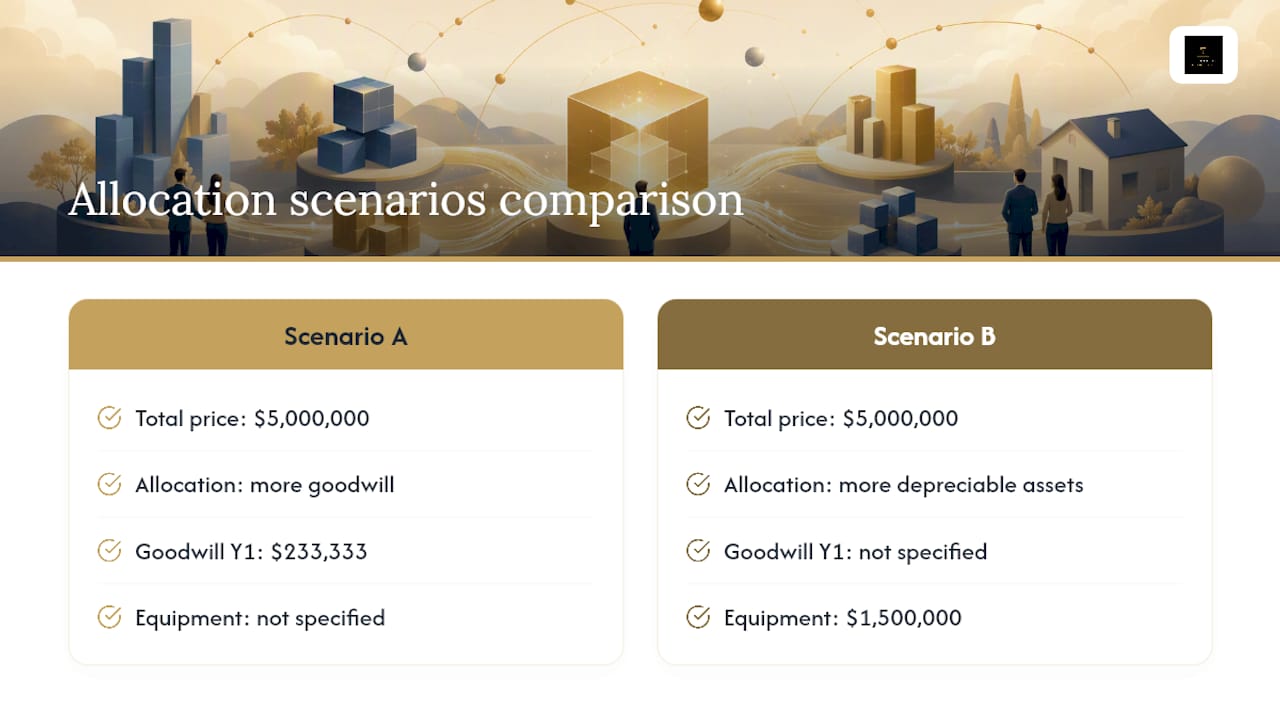
Assumptions: Total purchase price $5,000,000. Seller is an S-corp (no double-taxation issue). State tax excluded for simplicity. Equipment has been fully depreciated (§1245 recapture applies to full allocated value).
Scenario A (seller-favorable) vs Scenario B (buyer-favorable):
Seller tax result:
Scenario A saves the seller approximately $134,000 in federal tax compared to Scenario B, purely from the allocation difference.
Buyer amortization (goodwill only, 15-year straight-line):
In Scenario B, the buyer's equipment allocation ($1,500,000) may qualify for bonus depreciation or accelerated MACRS, potentially generating a larger first-year deduction than the goodwill amortization in Scenario A. The net present value of deductions, not just the total, is what drives buyer preference.
Deferred tax accounting entry (Scenario A, Year 1):
The buyer takes a $233,333 tax deduction for goodwill amortization. Under GAAP (public company, no book amortization), book expense is $0. Temporary difference: $233,333.
Journal entry: Debit Income Tax Expense $49,000 / Credit Deferred Tax Liability $49,000.
The Tax Refinery's perspective on goodwill allocation planning
Most business owners encounter goodwill allocation taxes once, maybe twice in a lifetime. That single encounter can cost or save hundreds of thousands of dollars depending on when the planning starts and how well the documentation holds up under scrutiny.
What I see consistently in transaction advisory work is that sellers arrive too late. The letter of intent is already signed, the buyer's counsel has drafted the purchase agreement, and the allocation schedule reflects the buyer's preferences. At that point, the seller's leverage is largely gone. The planning that actually moves the needle happens six to twelve months before a deal, when entity structure can still be adjusted, personal goodwill can be documented, and the seller has time to commission an independent valuation that will survive an IRS challenge.
The personal goodwill question deserves particular attention for any C-corp seller. The tax savings from properly documenting and selling personal goodwill at the individual level rather than through the corporation can be substantial. But the documentation has to be contemporaneous and credible. A valuation report prepared after the IRS sends a notice is not the same as one prepared before closing, and courts treat them very differently.
For buyers, the anti-churning rules and the treatment of contingent payments are the two areas most likely to produce unexpected results. Both require a careful read of the specific facts before the deal closes, not after.
Thetaxrefinery can help you navigate goodwill allocation planning

Goodwill allocation is one of the highest-stakes decisions in any business sale, and the window to plan it correctly is narrower than most owners expect. Thetaxrefinery works with business owners and their deal teams on transaction tax strategy, purchase-price allocation coordination, valuation supervision, Form 8594 review, and IRS audit representation when allocations are challenged.
Melissa Korber, Enrolled Agent, brings a practitioner's perspective to every transaction engagement: reviewing the Asset Purchase Agreement before signing, coordinating with valuation professionals to build a defensible allocation, and preparing both buyer and seller for the Form 8594 filing that follows. Whether you are preparing for a sale, evaluating an acquisition, or responding to an IRS inquiry about a prior allocation, the right time to engage is before the letter of intent is executed.
To discuss your transaction and what a proactive allocation strategy could mean for your after-tax outcome, book a consultation or review Thetaxrefinery's tax strategy services to find the engagement model that fits your situation.
Sources
The following sources provide direct access to the governing statutes, IRS guidance, and practitioner references cited throughout this article:
- Intangibles — IRS (Section 197) guidance
- 26 CFR § 1.197-2 — Treasury Regulation on Section 197
- Is Goodwill Tax Deductible: Section 197 Guide — Sofer Advisors
- PwC viewpoint: Deferred taxes related to goodwill (chapter excerpt)
- Transfers of personal goodwill in the sale of a closely held business — The Tax Adviser
This article is general information, not a substitute for advice from a qualified financial advisor. Consult a qualified financial professional about your own circumstances before acting on anything here.