
For most rental owners, the right entity is a limited liability company (LLC) that the IRS ignores for income tax purposes, paired with strong insurance. The LLC gives you legal separation. It does not change your federal tax bill by itself. The tax savings come from what you do inside the structure: depreciation, the qualified business income deduction, and how your rental income interacts with your other businesses and your W-2 pay. If you net $300,000 or more a year, the entity decision is worth making deliberately, because the wrong structure can leave deductions trapped or create a filing cost with no benefit.
This guide separates the two questions that get mixed together: who is liable if something goes wrong, and how the income is taxed.
TL;DR
- An LLC is a state-law liability tool. Members generally are not personally liable for the LLC's debts, but the LLC does not create a tax benefit on its own.
- A one-owner LLC is generally disregarded for federal income tax, and a multi-owner LLC is generally taxed as a partnership, unless the LLC elects corporate treatment.
- An S corporation is built for operating income that carries payroll. Rental income usually does not benefit from it, so it is rarely the default holding entity for a rental.
- The deductions that matter most for high earners (bonus depreciation, the 20% QBI deduction, passive loss limits) turn on how you operate and document the rental, not on the entity label.
- State taxes and fees can differ sharply by state, so price the structure before you form it.
Table of Contents
- Two questions, not one
- LLC versus your personal name
- How a rental LLC is taxed federally
- When an S corporation makes sense for rental property
- State taxes: the cost that surprises owners
- The deductions that matter more than the entity
- One LLC or several?
- A worked comparison
- A short checklist before you form the entity
- Perspective
- Where we can help
- FAQ
- Sources
Two questions, not one
Owners searching for the right entity usually ask one question: "LLC or S corp?" There are really two.
- Liability: If a tenant, guest or contractor sues over the property, what can they reach? This is decided under state law and by your insurance.
- Tax: How does the income, loss and depreciation reach your return? This is decided by federal tax classification, which is separate from the state-law entity you form.
An LLC is formed under state law, and the IRS explains that members generally are not personally liable for the entity's debts (IRS, Entities FAQ). Federal tax classification is a separate layer on top. That is why the same LLC can be taxed as a disregarded entity, a partnership or a corporation without changing its state-law status.
Keeping those layers apart makes every later decision easier.
LLC versus your personal name
Holding a rental in your own name is the simplest setup. Income and expenses go on Schedule E of your Form 1040, and there is no entity to maintain. The cost of simplicity is that a claim arising from the property can reach your personal assets, including assets unrelated to real estate.
An LLC places a legal boundary between the property and everything else you own. For a high earner with meaningful savings, a practice, or other businesses, that boundary is the main reason to use one.
Three practical points keep that boundary real:
- Insurance comes first. An LLC does not replace landlord liability coverage or an umbrella policy. It is a second layer.
- Keep the LLC separate. Use a dedicated bank account, sign leases in the LLC's name, and do not pay personal expenses from the LLC account. Blurred lines weaken the separation you formed the entity to create.
- Check your loan and title. Transferring a mortgaged property into an LLC can raise lender and title-insurance questions. Confirm terms with your lender before you deed anything.
The LLC also does not override the rules attached to the property itself. If the home sits in an association, the covenants (CC&Rs) can limit or prohibit rentals no matter who owns it. Understanding how an HOA unauthorized rental letter works shows why checking those rules before you buy or convert a property to a rental is part of the entity conversation.
How a rental LLC is taxed federally
The IRS default rules are straightforward. A domestic LLC with one owner is generally disregarded for federal income tax, and an LLC with two or more owners is generally classified as a partnership, unless it elects to be treated as a corporation (IRS, Entities FAQ).
| Structure | Default federal treatment | Where rental income is reported | Typical use |
|---|---|---|---|
| Your personal name | Individual | Schedule E on your Form 1040 | Simple, lower-value or single property |
| Single-member LLC | Disregarded entity | Schedule E on your Form 1040 | Liability separation with no change in tax |
| Multi-member LLC | Partnership | Form 1065, with a K-1 to each member | Rentals owned with partners or family |
| LLC electing S corp | S corporation | Form 1120-S, with a K-1 to each shareholder | Operating businesses with payroll, in specific cases |
The consequence is that moving a rental from your name into a single-member LLC leaves your federal income tax result the same. That is a good outcome: you add protection without adding a tax return. It also explains a common point in owner forums, that an LLC is about legal separation rather than tax savings.
A multi-member LLC does add a return. Our published fee for a Form 1065 is $1,800, so a partnership structure should earn its place through the ownership it reflects, not through habit.
Elections: Form 8832 and Form 2553
An eligible LLC can change its tax classification by election. The IRS identifies Form 8832 for an eligible LLC electing corporate classification and Form 2553 for an eligible entity electing S corporation status (IRS, Entities FAQ). Elections have deadlines and consequences, so they belong in a plan, not in a guess.
When an S corporation makes sense for rental property
An S corporation is a tax classification that can reduce self-employment tax on a business whose owner works in it, because the owner can be paid a reasonable salary plus distributions. That mechanism is why S-corp planning is popular with business owners netting $300,000 to $1,000,000.
Rental income does not usually work that way. Passive rental income is generally not subject to self-employment tax in the first place, so there is no payroll tax to trim. Placing a rental inside an S corporation adds a return, payroll and ownership rules without reaching the savings the election is designed for. Our guide on S corp passive income explains what counts as passive income inside an S corporation and when tax applies.
There are also ownership considerations. Property held in a corporation is harder to move out later than property held in a disregarded LLC, and you should look at those exit costs before electing. For a side-by-side view of the two structures, see our comparison of S corp vs LLC.
Where an S corporation does fit your picture is the operating business that sits next to your real estate: your practice, your trade company, your cleaning or HVAC business. A common pattern is an S corporation for the operating company and a separate LLC for the real estate. That separation also matters for liability, because a lawsuit against the operating company then does not automatically reach the building.
If you own the building your own business uses, the self-rental rules apply. They can turn rental income into non-passive income and affect how losses are used, which we cover in self rental rules for business owners.
State taxes: the cost that surprises owners
Federal treatment is only part of the cost. States layer on their own fees and taxes, and they do not all follow the same approach.
California is a useful example of how much it can matter. The California Franchise Tax Board says California generally follows federal LLC classification, yet disregarded and partnership-classified LLCs are generally subject to an $800 annual tax when its activity or registration conditions apply (FTB Publication 3556). That tax can apply even when a single-member LLC reports its income on its owner's return. California also imposes a general franchise or income tax on S corporations at 1.5%, even though federal S corporation treatment is generally pass-through (FTB Publication 1123).
Other states have their own annual fees, registered-agent requirements and filing rules. Before you form an LLC, price the full annual cost in the state where the property sits, since that state's rules usually matter even if the LLC is formed elsewhere. If you hold properties in several states, the number of registrations grows with them.
The deductions that matter more than the entity
For a high earner, the real money in rental real estate is rarely in the entity label. It is in four areas.
Bonus depreciation and Section 179
The One Big Beautiful Bill Act (Public Law 119-21, signed July 4, 2025) permanently restored 100% bonus depreciation for qualified property acquired after January 19, 2025, and raised the Section 179 limit to $2,500,000 (Congressional Research Service). Bonus depreciation applies to qualifying components, often identified through a cost segregation study, not to the building shell. For short-term rentals specifically, see our walkthrough of bonus depreciation for short-term rentals, and our comparison of Section 179 and bonus depreciation helps you choose between them.
The 20% QBI deduction
The 2025 law made the 20% Section 199A qualified business income deduction permanent. For tax years beginning after December 31, 2025, it also widened the phase-in range and added a $400 minimum deduction for certain taxpayers (Pennsylvania CPA Journal). For 2026 the thresholds are $201,750 for single filers and $403,500 for joint filers. Above the threshold, the deduction is limited by W-2 wages or by wages plus 2.5% of the unadjusted basis of depreciable property, which is where owners with larger rental portfolios look at the property side of the formula.
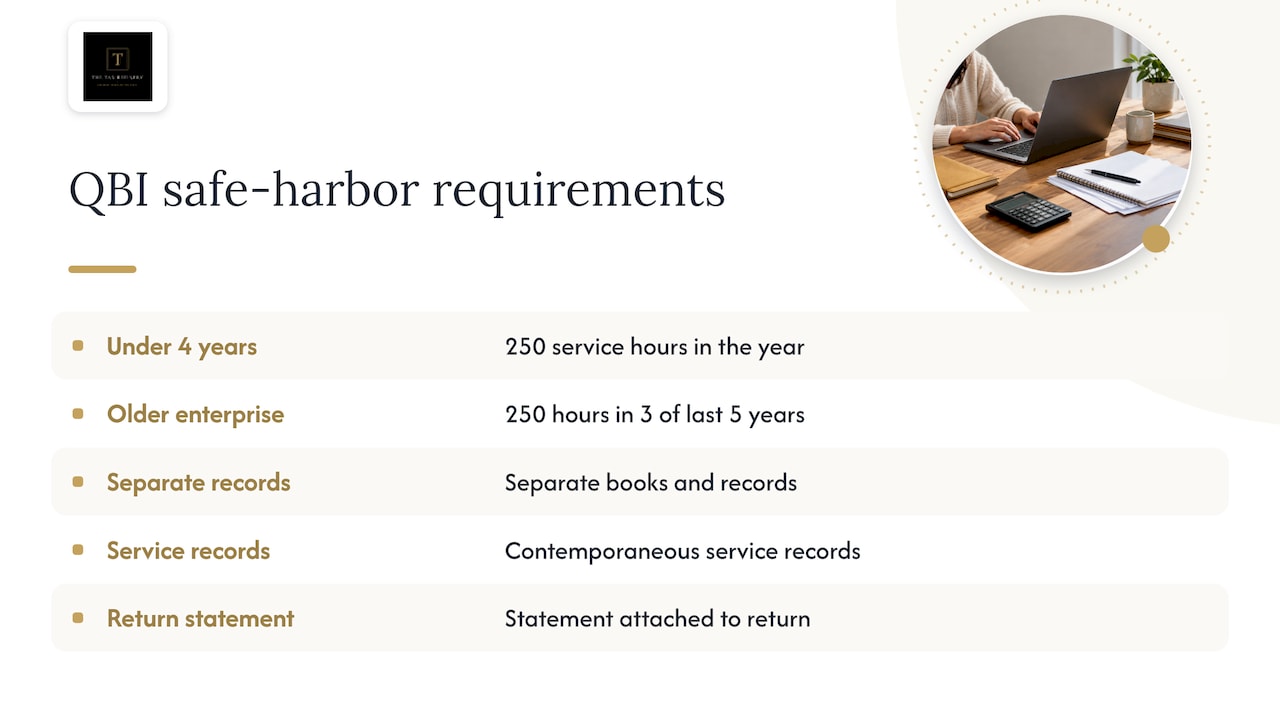
A rental does not qualify automatically. IRS Revenue Procedure 2019-38 provides a safe harbor under which a rental real estate enterprise can be treated as a trade or business for the deduction. It requires separate books and records, and contemporaneous records of services. An enterprise under four years old needs 250 hours of rental services in the year, while an older one needs 250 hours in three of the last five years. A statement must also be attached to the return (IRS Revenue Procedure 2019-38). A disregarded single-member LLC's rental enterprise can use the safe harbor when those conditions are met, though the LLC does not make you eligible on its own. Our post on the 250-hour QBI safe harbor shows how owners document the hours.
Passive loss rules
The IRS says a rental activity is passive even if you materially participate, unless you qualify as a real estate professional. It is not treated as a rental activity if average customer use is 7 days or less, or 30 days or less with significant personal services (IRS Publication 925). That second rule is why short-term rentals are treated differently, and why the details matter. Our article on the short-term rental 14-day rule covers the common misses.
Separately, noncorporate taxpayers' net business losses above the excess business loss limit are disallowed for the year and carried forward as a net operating loss (same IRS publication). For 2026 that cap is $256,000 for single filers and $512,000 for joint filers, and the 2025 law made it permanent (Congressional Research Service).
Deductible operating costs
IRS Publication 527 covers the day-to-day expenses of a residential rental, and the 2025 standard mileage rate for operating a vehicle rose to 70 cents per mile (IRS Publication 527). Mileage and expenses are only as valuable as the records behind them, which is another reason to keep a separate account for each rental entity.
One LLC or several?
Owners with more than one property face a second question. Placing every property in a single LLC is simple, but a claim against one property can then reach the equity in the others inside that LLC. Giving each property its own LLC isolates risk, at the cost of more filings and fees. A series LLC, available in some states, tries to offer that separation under one umbrella, but federal and state filing treatment is not uniform. We explain it in series LLC taxes.
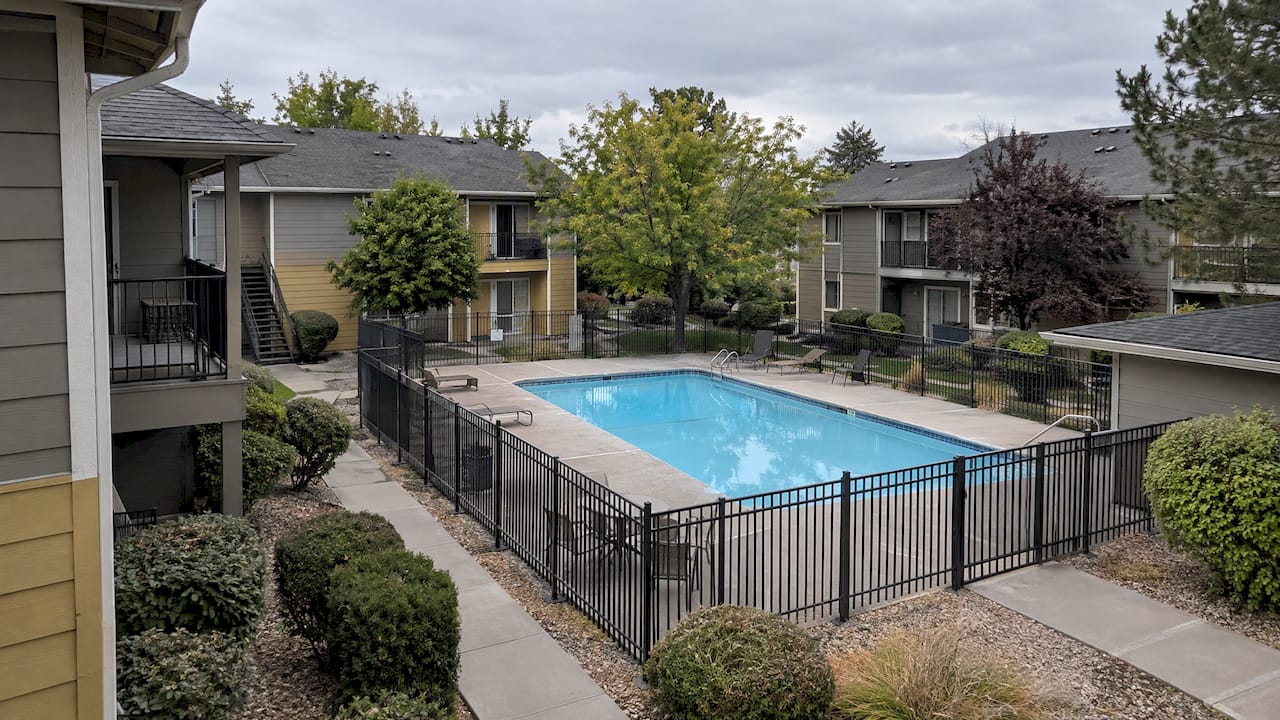
A workable rule is to group properties by risk. A single-family rental with a modest mortgage and a multi-unit building with a pool do not carry the same exposure, and they need not share a structure.
A worked comparison
This is a simplified, hypothetical example, not a quote or a promise of results.
Imagine a married nurse practitioner couple filing jointly, with taxable income below the 2026 joint threshold of $403,500, who own two rentals. Their net rental income before the QBI deduction is $60,000.
- Personal name: the $60,000 is reported on Schedule E. If the QBI safe harbor conditions are met, the deduction can be up to 20% of qualified income, or $12,000, subject to the taxable income limits. They have no liability separation.
- Single-member LLC for each property: federal tax is the same, because the LLCs are disregarded. They gain liability separation and keep the ability to use the safe harbor, provided they keep separate books and record their hours.
- S corporation holding both rentals: the income is still passive rental income with no self-employment tax to reduce. They add an 1120-S, payroll complexity and ownership constraints.
The disregarded LLC gives the protection without a tax penalty. If their taxable income were above the threshold, the wage and property-basis limits would apply, and the answer would depend on the depreciable basis of the properties and any related business structure.
A short checklist before you form the entity
- Confirm the property's mortgage, title and insurance terms for a transfer.
- Decide whether each property needs its own LLC or can share one with similar risk.
- Price state formation and annual costs where the property sits.
- Decide whether any owner is actively working in a business that belongs in a separate S corporation.
- Set up separate books and an hours log from the first day, so the QBI safe harbor and passive-activity positions are supportable.
- Map how rental income, depreciation and losses will interact with your W-2 income or practice income.
Perspective
When a high earner asks us about an entity for a rental, the question underneath is usually "how do I keep more of what I earn?" The entity is one part of that answer, and often the smaller part.
We start with the whole picture: your operating business, your W-2 or practice income, your real estate, and your state. The right structure for the building is often a plain LLC. The structure for the business that runs next to it may be an S corporation. Getting those two decisions to work together is what turns a filing into a plan.
That is why our work is built around year-round strategy rather than a once-a-year conversation. Depreciation timing, QBI documentation, accountable plans and entity elections all move with your income, and they are easier to use well when someone is looking at them before year-end, not after.
Strategy That Pays You Back is our tagline because the goal is measurable: what you can retain, redirect and reinvest.
Melissa
Where we can help
If you own rentals alongside a practice or business, our Monthly Tax Advisory is $11,997 per year and our Quarterly Tax Strategy Sessions are $9,497 per year. Both are built for year-round planning. If your question is specifically about an S corporation for your operating business, the S-Corp Tax Strategy Accelerator is $997 one-off. Rental owners can also see our published preparation fees on the fee schedule, where an Investor or Rental Owner return is $550.

To see how an entity, depreciation and QBI would fit together for you, start at The Tax Refinery.
FAQ
Do I need an LLC for a rental property?
No law requires one, but an LLC is the common way to separate the property's liabilities from your personal assets. Members generally are not personally liable for the LLC's debts under state law, according to the IRS. Pair it with landlord insurance, since the LLC does not replace coverage.
Is an LLC or an S corp better for rental property?
For most rentals, a single-member LLC taxed as a disregarded entity is the better fit. An S corporation is designed for businesses that pay the owner a salary, and rental income usually has no self-employment tax to reduce. An S corporation tends to belong with your operating business instead.
How are rental LLC taxes reported?
A single-member LLC generally reports rental income on Schedule E of the owner's Form 1040. A multi-member LLC generally files a Form 1065 and issues a K-1 to each member, unless it elects corporate treatment. State filings and fees are separate.
Does putting a rental in an LLC lower my taxes?
Not by itself. A disregarded LLC leaves your federal income tax result the same. Savings come from depreciation, the QBI deduction when its conditions are met, and sound planning around passive loss limits.
Sources
- IRS, Entities FAQ
- IRS Revenue Procedure 2019-38
- FTB Publication 3556
- FTB Publication 1123
- Congressional Research Service, Tax Provisions in P.L. 119-21
- Pennsylvania CPA Journal, OBBBA growth incentives
- IRS Publication 925
- IRS Publication 527