
Yes — both the backdoor Roth IRA and the mega backdoor Roth remain fully available in 2026. No legislation has eliminated either strategy, and the IRS continues to allow nondeductible traditional IRA contributions followed by Roth conversions with no income ceiling on the conversion itself. Here is what you need to know before you act:
- 2026 IRA contribution limit: $7,500 (under 50) or $8,600 (age 50 or older)
- §415(c) total addition limit for 401(k) plans: $72,000, which sets the ceiling for mega backdoor headroom
- Form 8606 is mandatory for every backdoor Roth — skipping it creates a basis-tracking problem that can cost you real money later
- SECURE 2.0 introduces mandatory Roth catch-up treatment for employees whose prior-year FICA wages exceeded $150,000, effective January 1, 2026 — this changes payroll coding and plan design for many business owners
Three questions determine whether you proceed now or call an advisor first: Do you carry pre-tax IRA balances that would trigger the pro-rata rule? Does your 401(k) plan document allow after-tax contributions plus in-plan Roth conversions or in-service distributions? Are you building Roth assets specifically to eliminate required minimum distributions (RMDs) for legacy planning? If the answer to the first question is yes and you cannot roll those pre-tax funds into a 401(k), the backdoor Roth math changes significantly. If the answer to the second is no, the mega backdoor is off the table until the plan is amended.
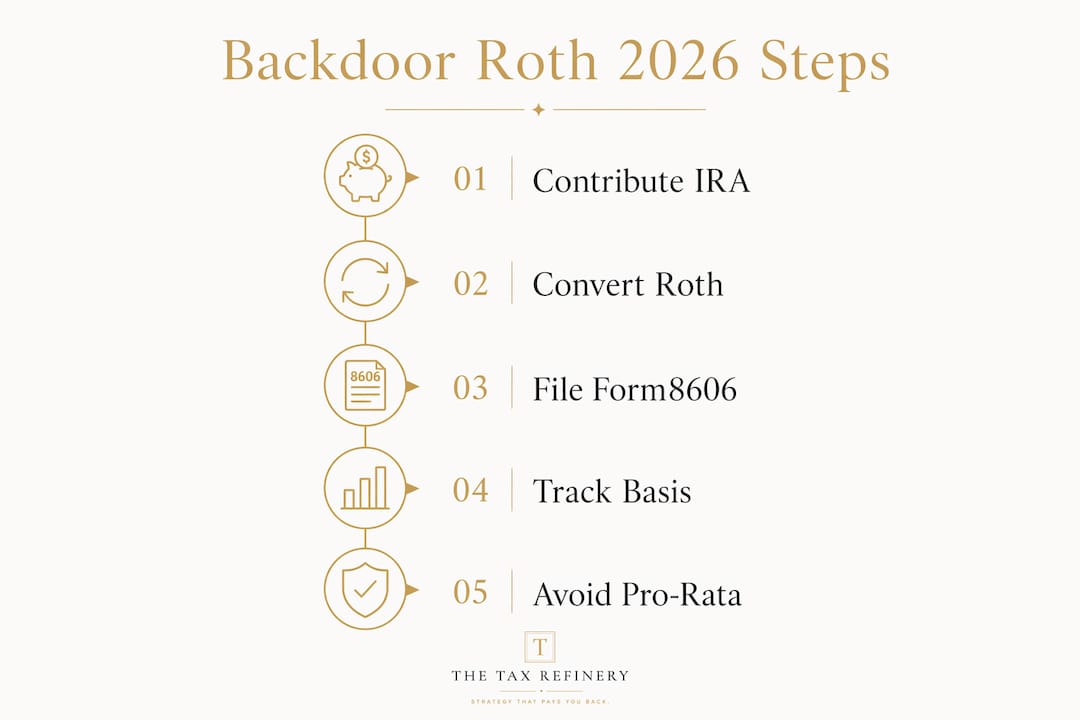
The short action path: contribute to a traditional IRA on a nondeductible basis, convert to Roth promptly (same-day or within days), and file Form 8606 with your return. For the mega backdoor, confirm plan provisions in writing before making after-tax 401(k) contributions, then convert in-plan or distribute to a Roth IRA.

Roth accounts carry no lifetime RMDs, which makes them particularly valuable for legacy and tax-free growth — a point that resonates strongly with Oregon business owners and high earners building multigenerational wealth.

Table of Contents
- What are the 2026 contribution limits and income phaseouts?
- How does a backdoor Roth conversion actually work?
- What is the pro-rata rule and how do you avoid a surprise tax bill?
- How does the mega backdoor Roth work in 2026?
- What SECURE 2.0 changes affect Roth conversions in 2026?
- What mistakes do people make when filing Form 8606?
- Your 2026 backdoor Roth execution checklist
- When does a backdoor Roth strategy not make sense?
- Key Takeaways
- Why most high earners leave this money on the table
- Thetaxrefinery can handle your 2026 Roth planning from start to finish
- Useful sources and further reading
What are the 2026 contribution limits and income phaseouts?
The numbers below are the ones to use for all 2026 planning. Using outdated figures is one of the most common errors advisors see.
| Limit Type | Amount | Notes |
|---|---|---|
| IRA contribution (under 50) | $7,500 | Applies to traditional and Roth combined |
| IRA contribution (age 50+) | $8,600 | Includes catch-up; applies to traditional and Roth combined |
| 401(k) elective deferral (under 50) | The IRS deferral limit for 2026 for participants under age 50 | Pre-tax or Roth deferrals |
| 401(k) catch-up (age 50–59) | The IRS catch-up contribution limit for 2026 for eligible ages | Added to elective deferral |
| Super catch-up (ages 60–63) | The enhanced 2026 catch-up amount introduced by SECURE 2.0 for specified ages | SECURE 2.0 provision, replaces standard catch-up |
| §415(c) total addition limit | The IRS total annual addition limit for 2026 combining all contribution sources | All sources: deferrals + employer + after-tax |
The 2026 IRA limit of $7,500 (or $8,600 with catch-up) applies regardless of income — there is no income restriction on making a nondeductible traditional IRA contribution. That is the entire foundation of the backdoor strategy.
Direct Roth IRA income phaseouts for 2026: Single filers begin phasing out at $150,000 MAGI and lose eligibility entirely at $165,000. Married filing jointly phases out between $236,000 and $246,000. If your income exceeds those thresholds, a direct Roth contribution is not available — which is exactly why the backdoor route exists.
Mega backdoor headroom depends on how much of the $72,000 §415(c) ceiling remains after your elective deferrals and employer contributions. A business owner who defers $24,500 and receives $10,000 in employer match has $37,500 of remaining headroom for after-tax contributions — all of which can be converted to Roth if the plan allows it.
- Backdoor Roth: available to anyone with earned income, regardless of MAGI
- Mega backdoor Roth: available only if the 401(k) plan document permits after-tax contributions AND either in-plan Roth conversions or in-service distributions
- Direct Roth IRA: income-limited; phaseout begins at $150,000 (single) and $236,000 (MFJ) for 2026
How does a backdoor Roth conversion actually work?
The mechanics are straightforward, but the sequencing and documentation matter. Follow these steps exactly.
- Open or use an existing traditional IRA. If you already have one, check the balance for pre-tax funds before proceeding — this is the pro-rata gate (covered in the next section).
- Make a nondeductible contribution for the 2026 tax year. You have until the tax filing deadline (typically April 15, 2027) to make a contribution that counts for 2026. Contribute the full $7,500 (or $8,600 if you are 50 or older).
- Convert to Roth promptly. Same-day or within a few days is the standard practice. The IRS accepts same-day conversions, and converting quickly minimizes any earnings that would become taxable. Vanguard's guidance confirms this approach and walks through the custodial steps.
- File IRS Form 8606. This form documents your nondeductible contribution (Part I) and the conversion (Part II). It creates the basis record that tells the IRS your principal is not taxable.
- Retain all custodial confirmations. Keep the contribution confirmation, the conversion confirmation, and any 1099-R and 5498 forms you receive. These are your audit trail.
Example calculation: You contribute the applicable nondeductible traditional IRA limit to a traditional IRA and convert the full balance to Roth shortly thereafter. Two days of earnings on $7,500 at a money market rate might produce $2–$3. That $2–$3 is taxable; the $7,500 principal is not, because it was a nondeductible contribution documented on Form 8606. Your tax bill on this conversion is effectively zero on the basis.
Pro Tip: Convert within the same week as your contribution. Every day the funds sit in the traditional IRA as an investment, any gains become taxable on conversion. A same-day internal transfer at your custodian eliminates this entirely.
The Form 8606 instructions are available directly from the IRS and walk through each line. The form is not complicated, but omitting it is a serious error — the IRS has no record of your basis, and future distributions could be taxed twice.
What is the pro-rata rule and how do you avoid a surprise tax bill?
The pro-rata rule is the most misunderstood part of the backdoor Roth. It does not care which dollars you convert — it treats all your traditional, SEP, and SIMPLE IRA balances as a single pool.
The formula:
Taxable portion of conversion = (Pre-tax IRA balance ÷ Total IRA balance) × Amount converted
Worked Example 1 — Clean slate (no pre-tax IRAs):
You have no pre-tax IRA funds. You make a nondeductible contribution of $7,500 (or $8,600 if age 50+) and convert the full amount.
- Taxable portion = ($0 ÷ $7,500) × $7,500 = $0
The entire conversion is tax-free on the principal. This is the ideal scenario.
Worked Example 2 — Rollover IRA exists:
You have a substantial pre-tax rollover IRA balance and contribute $7,500 (or $8,600 if age 50+) as nondeductible IRA limit.
- Taxable portion = ($200,000 ÷ $207,500) × $7,500 = $7,229 (for under 50)
You owe ordinary income tax on $7,229 — roughly 96% of the conversion. At a 32% federal rate, that is about $2,313 in federal tax on a $7,500 conversion. The backdoor Roth becomes far less attractive in this scenario.
| Scenario | Pre-tax IRA Balance | Nondeductible Contribution | Taxable on Conversion |
|---|---|---|---|
| Clean slate | $0 | $7,500 (or $8,600 age 50+) | $0 |
| Small rollover IRA | — | $7,500 (or $8,600 age 50+) | — |
| Large rollover IRA | $200,000 | $7,500 (or $8,600 age 50+) | $7,229 (for $7,500 contrib) |
Avoidance tactics that work:
- Roll pre-tax IRA funds into your employer 401(k) before December 31. The pro-rata test uses the December 31 balance of the conversion year. If the rollover clears before year-end, those funds are out of the IRA pool.
- Confirm the 401(k) accepts incoming rollovers. Not all plans do. Get written confirmation from your plan administrator and start the process by mid-November — rollovers can take 2–4 weeks to process.
- Convert only after the rollover has settled. Timing matters: if you convert in January 2026 but the rollover does not clear until February 2026, the December 31, 2025 balance is what counts for the 2025 tax year.
Pro Tip: Ask your 401(k) plan administrator for a written confirmation that the plan accepts IRA rollovers and the expected processing timeline. Give that document to your CPA before year-end. It is the single most important piece of paper in a pro-rata avoidance strategy.
Fidelity's guidance reinforces this point: conversions are taxable to the extent pre-tax assets exist, and the strategy works best as a long-term planning layer rather than a one-time maneuver.
How does the mega backdoor Roth work in 2026?
The mega backdoor Roth can move tens of thousands of dollars into Roth each year — but only if your plan is designed for it. Most off-the-shelf employer plans are not.
Two routes to Roth under the mega backdoor:
- In-plan Roth conversion: After-tax contributions stay inside the 401(k) and convert to the Roth sub-account within the plan. Funds remain in the plan's investment menu; no distribution occurs.
- In-service distribution to a Roth IRA: After-tax contributions are distributed while you are still employed and rolled directly into a Roth IRA. This gives you broader investment options and removes the funds from the plan's fee structure.
Headroom calculation example:
| Component | Amount |
|---|---|
| §415(c) total addition limit | $72,000 |
| Less: employee elective deferrals | ($24,500) |
| Less: employer match/profit sharing | ($10,000) |
| After-tax contribution headroom | $37,500 |
That $37,500 can be contributed as after-tax (non-Roth) and then converted to Roth — either in-plan or via in-service distribution. For business owners in Oregon earning $400,000 or more, that is a substantial annual Roth contribution on top of the standard backdoor IRA.
Plan document checklist — your plan must allow all of the following:
- After-tax (non-Roth) employee contributions as a separate contribution type
- In-plan Roth conversions of the after-tax sub-account, OR in-service distributions of after-tax funds
- Ideally, automatic conversion elections to minimize earnings in the after-tax bucket before conversion
ACP testing and compliance constraints are the primary barrier in standard employer plans. ACP nondiscrimination testing compares after-tax contribution rates between highly compensated employees (HCEs) and non-highly compensated employees (NHCEs). If only HCEs use the after-tax feature, the plan may fail ACP testing, forcing a corrective distribution. Owner-only plans and solo 401(k)s sidestep this problem entirely because there are no NHCEs to test against.
For business owners designing their own plan, the most reliable path is an owner-only or partner-only plan that explicitly permits after-tax contributions and in-service distributions. This design approach is the most consistent way to get annual mega backdoor access without compliance friction.
Execution steps for owners:
- Work with a third-party administrator (TPA) to amend the plan document to allow after-tax contributions and in-service distributions.
- Confirm payroll coding separates after-tax contributions from pre-tax and Roth deferrals.
- Make after-tax contributions throughout the year or in a lump sum before year-end.
- Convert in-plan or request an in-service distribution to your Roth IRA promptly after each contribution.
- Document every step: plan amendment, payroll records, conversion confirmations.
What SECURE 2.0 changes affect Roth conversions in 2026?
SECURE 2.0 introduced several provisions that directly affect how high earners and business owners use Roth strategies in 2026. These are not theoretical — they require action at the payroll and plan-document level.
Mandatory Roth catch-up contributions (effective January 1, 2026):
Employees whose prior-year FICA wages from the same employer exceeded $150,000 must make catch-up contributions on a Roth (after-tax) basis only. Pre-tax catch-up contributions are no longer permitted for this group. If your plan does not have a Roth feature, catch-up contributions may be disallowed entirely until the plan is amended. Payroll must code these correctly — a miscoded catch-up contribution creates a compliance problem.
Super catch-up for ages 60–63:
The super catch-up amount of $11,250 replaces the standard $8,000 catch-up for participants aged 60–63. This increases the §415(c) ceiling for that age group and expands mega backdoor headroom. A 61-year-old business owner can defer $24,500 + $11,250 = $35,750 in elective deferrals, leaving $36,250 of after-tax headroom under the $72,000 §415(c) cap (before employer contributions).
Additional 2026 regulatory notes:
- Roth SEP IRA and Roth SIMPLE IRA options are now permitted under SECURE 2.0, but many custodians have not yet implemented these features. Verify availability with your custodian before planning around them.
- The IRS has confirmed that same-day contribute-and-convert transactions are permissible. Retain custodial confirmations showing the contribution date and conversion date as documentation.
- SECURE 2.0's Rothification push means more retirement savings flow into Roth form for high-wage earners — confirm with your payroll provider that catch-up contributions are coded as Roth where required.
What mistakes do people make when filing Form 8606?
Execution errors on backdoor Roth transactions are common, and most of them are avoidable with proper documentation and sequencing.
Most frequent mistakes:
- Skipping Form 8606 entirely. Without this form, the IRS has no record of your nondeductible basis. Future distributions may be taxed again on the same dollars. File it even when the conversion appears fully non-taxable.
- Leaving pre-tax IRAs unrolled. Failing to roll rollover IRAs into a 401(k) before converting triggers the pro-rata rule and produces an unexpected tax bill.
- Waiting too long to convert. Letting funds sit in the traditional IRA as investments creates taxable earnings. Convert within days of contributing.
- Misreading the plan document. Assuming a 401(k) allows after-tax contributions or in-service distributions without confirming in writing. The Summary Plan Description (SPD) is the authoritative document.
- Mismatching tax years. Contributing for 2026 (up to April 15, 2027) but converting in 2027 creates a timing mismatch that requires careful Form 8606 tracking across two tax years.
Required forms and where they appear:
- Form 8606, Part I: Reports the nondeductible IRA contribution and tracks cumulative basis.
- Form 8606, Part II: Reports the Roth conversion and computes the taxable portion.
- Form 1040, Line 4: The gross distribution from the conversion appears here; the taxable amount (usually $0 on basis) appears on Line 4b.
- 1099-R: Issued by the custodian showing the conversion amount; code "2" in Box 7 typically indicates a Roth conversion.
- Form 5498: Confirms the IRA contribution; useful for cross-referencing with Form 8606.
Documentation checklist:
- Custodial contribution confirmation (date, amount, account type)
- Conversion or rollover confirmation (date, amount, destination account)
- 401(k) plan SPD excerpt showing after-tax contribution feature and in-service distribution policy
- Written confirmation from plan administrator that IRA rollovers are accepted
Pro Tip: File Form 8606 every year you make a nondeductible contribution, even if you convert the same year. The IRS can assess a $50 penalty for a missing Form 8606, but the bigger risk is losing your basis record and paying tax twice on the same dollars years later.
Your 2026 backdoor Roth execution checklist
Use this sequence to execute the backdoor or mega backdoor Roth in 2026. Hand it directly to your CPA or plan administrator.
Backdoor Roth IRA — step sequence:
- Confirm all traditional, SEP, and SIMPLE IRA balances as of the current date.
- If pre-tax IRA balances exist, initiate rollover to employer 401(k) by mid-November 2026 to clear before December 31.
- Obtain written confirmation from the 401(k) plan administrator that the plan accepts incoming IRA rollovers.
- Once rollover clears (or if no pre-tax IRAs exist), contribute $7,500 (or $8,600 if age 50+) to a traditional IRA on a nondeductible basis.
- Convert the full traditional IRA balance to Roth within days of contribution.
- Retain contribution confirmation, conversion confirmation, 1099-R, and Form 5498.
- File Form 8606 with your 2026 tax return (due April 15, 2027, or October 15, 2027 with extension).
Mega backdoor Roth — additional steps:
- Request the plan's Summary Plan Description and confirm after-tax contributions and in-service distributions are permitted.
- Calculate after-tax headroom: $72,000 minus your elective deferrals minus employer contributions.
- Instruct payroll to code after-tax contributions separately from pre-tax and Roth deferrals.
- Make after-tax contributions throughout the year or in a lump sum.
- Convert in-plan or request an in-service distribution to your Roth IRA promptly after each contribution.
- Retain plan amendment, payroll records, and conversion confirmations.
Key deadlines:
- IRA contribution deadline for 2026: April 15, 2027 (no extension)
- Conversion must occur in the calendar year you want it to count (December 31, 2026 for a 2026 conversion)
- Pro-rata test uses December 31, 2026 IRA balances — rollover must clear by that date
Who to contact:
- Custodian (Vanguard, Fidelity, or your broker): for contribution, conversion, and rollover mechanics
- Plan administrator or TPA: for SPD excerpt, plan amendment, and in-service distribution policy
- CPA or Enrolled Agent: for Form 8606 preparation, pro-rata math, and multi-year conversion planning
When does a backdoor Roth strategy not make sense?
The backdoor Roth is not the right move in every situation. Several conditions make it a poor fit or outright counterproductive.
Red flags that suggest pausing:
- You carry large aggregated pre-tax IRA balances and cannot roll them into a 401(k). The pro-rata math may make the conversion mostly taxable, eliminating the benefit.
- You expect to be in a significantly lower tax bracket in retirement. Pre-tax deferral now and taxable distributions later may produce a better net outcome than paying tax now for Roth treatment.
- You need the funds within five years. Roth conversions are subject to a five-year aging rule for penalty-free withdrawal of converted amounts before age 59½. A short investment horizon undermines the strategy.
- Your 401(k) plan does not allow after-tax contributions or in-service distributions, and you are not in a position to amend it. The mega backdoor is simply unavailable without these plan features.
Plan design blockers for the mega backdoor:
- No after-tax contribution feature in the plan document
- No in-plan Roth conversion option and no in-service distribution policy
- ACP testing would likely fail because only HCEs are using the after-tax feature
When to call a professional:
- Pro-rata math produces a tax bill larger than the expected Roth benefit
- Plan documents are ambiguous about in-service distribution eligibility
- You are coordinating a Roth conversion with estate planning, charitable giving, or a business sale
- Legislative risk matters to your long-term plan (Congress has proposed limiting backdoor Roth strategies in prior budget cycles; no such restriction is law as of 2026, but the risk is real for multi-year planning)
For a broader view of how Roth conversions fit into a high-earner tax strategy, the interaction with capital gains timing, business income, and depreciation recapture is worth modeling before you commit.
Key Takeaways
Both the backdoor Roth IRA and the mega backdoor Roth remain fully available in 2026, with the IRA limit at $7,500 ($8,600 for those 50 or older) and the §415(c) ceiling at $72,000 — but execution depends entirely on clean IRA balances, correct plan documents, and Form 8606 filed every year.
| Point | Details |
|---|---|
| 2026 IRA limit | $7,500 under 50; $8,600 age 50 or older — no income restriction on nondeductible contributions. |
| Pro-rata rule | Roll pre-tax IRA balances into a 401(k) before December 31 to keep the conversion tax-free. |
| Mega backdoor headroom | $72,000 §415(c) limit minus deferrals and employer contributions equals after-tax capacity. |
| Form 8606 is mandatory | File it every year you make a nondeductible contribution — omission risks double taxation on basis. |
| Thetaxrefinery | Provides Form 8606 review, rollover coordination, and plan design support for Oregon business owners executing these strategies. |
Why most high earners leave this money on the table
The mechanics of the backdoor Roth are not complicated. What stops most high earners from executing it correctly is the sequence of decisions that has to happen before the contribution: checking IRA balances, confirming plan documents, initiating rollovers in time, and then filing the right forms. Each step is manageable on its own. Together, they require coordination that most people do not have bandwidth for in the middle of running a business or a demanding career.
The pro-rata rule is where the strategy most often breaks down. A client discovers a $180,000 rollover IRA sitting at a former employer's custodian — one they had forgotten about — and suddenly a "tax-free" conversion becomes a mostly taxable event. The fix exists (roll it into the current 401(k)), but it has to happen before December 31 of the conversion year, and that window closes faster than people expect.
The mega backdoor is a different kind of problem. The math is straightforward once you know the plan allows it. The issue is that most business owners do not know what their plan documents actually say. They assume the 401(k) their payroll company set up covers everything. It usually does not. An after-tax contribution feature and an in-service distribution provision are not standard — they require deliberate plan design.
For clients who are building Roth assets specifically to eliminate RMDs and create tax-free legacy wealth, the Roth IRA's no-RMD advantage is one of the most durable benefits in the tax code. Pairing that with a self-directed IRA for alternative assets is a strategy worth discussing with an advisor if diversification is part of the legacy plan. The payoff from getting this right compounds over decades. The cost of getting it wrong is a tax bill that did not need to exist.
Thetaxrefinery can handle your 2026 Roth planning from start to finish
Executing a backdoor or mega backdoor Roth correctly in 2026 means coordinating IRA balances, plan documents, payroll coding, and tax filings — all within specific calendar-year deadlines. Thetaxrefinery handles exactly this kind of multi-step, high-stakes planning for business owners and high earners across Oregon and beyond.

The firm's services directly relevant to this strategy include Form 8606 preparation and review, rollover coordination to eliminate pro-rata exposure, plan design for S-corp and owner-only 401(k)s that permit after-tax contributions and in-service distributions, and multi-year Roth conversion sequencing. Melissa Korber, EA, works with clients to build the documentation package their CPA or plan administrator needs — contribution confirmations, SPD excerpts, rollover timelines, and conversion records.
To get started, visit the tax strategy comparison page to see how Thetaxrefinery's advisory model fits your situation. Bring your most recent IRA statements, your 401(k) plan's Summary Plan Description, and a rough estimate of your 2026 MAGI. Remote engagements are available for Oregon clients who prefer to work virtually. If you want to run the numbers first, the tax planning calculator is a useful starting point before the first conversation.
Useful sources and further reading
The following primary sources support the figures and guidance in this article. Your advisor or plan administrator can use these to verify numbers and confirm plan rules.
- IRS: Rollovers of After-Tax Contributions in Retirement Plans — authoritative IRS guidance on rolling after-tax funds between plans
- IRS Form 8606 Instructions — line-by-line instructions for reporting nondeductible contributions and conversions
- IRS: About Form 8606 — overview and filing requirements
- IRS: 401(k) limit increases to $24,500 for 2026, IRA limit increases to $7,500 — official 2026 contribution limits
- IRS Publication 560 — retirement plans for small businesses, including SEP and SIMPLE rules
- IRS Notice 25-67 — IRS guidance relevant to plan design and catch-up contribution rules
- Vanguard: How to set up a backdoor Roth IRA — custodial walkthrough of the contribute-and-convert process
- Fidelity: Backdoor Roth IRA — practical guidance on taxable events and five-year rules
- Ascensus: What is the Mega Backdoor Roth Strategy? — plan document requirements and ACP testing implications
- Thetaxrefinery: Tax Strategy Services — advisory and plan design services for business owners executing these strategies
This article is general information, not professional tax or legal advice. Contribution limits, phaseouts, and plan rules can change. Confirm current figures with the IRS or a qualified tax professional before executing any strategy described here.
Recommended
- Tax Planning for High Earners: 2026 Strategy Guide
- The Tax Refinery — Tax Strategy, Preparation & Resolution | Boise, ID
- How to Build Wealth Through Strategic Tax Planning | The Tax Refinery
- IRS Opens the Door for Crypto Staking Inside Trusts — But Only If You Follow the New Rules Exactly | The Tax Refinery