
Straight-line depreciation spreads an asset's cost evenly across its useful life. Accelerated depreciation, which includes MACRS (the IRS's standard tax system) and bonus depreciation, moves more of that deduction into the early years. For a business owner or investor with high taxable income, the choice decides how much tax you pay this year versus later, and it is rarely a decision to leave to the default setting on your return. At The Tax Refinery, depreciation strategy is part of the year-round planning we do for owners, investors and multi-entity operators.
TL;DR
- Straight-line deducts the same amount every year. Accelerated methods deduct more early and less later, and the total deduction over the asset's life is the same.
- For federal tax, most property must use MACRS, an accelerated system with preset percentages by asset class. Straight-line is available by election within MACRS.
- Under the 2025 law change (OBBBA), a permanent 100% first-year bonus deduction applies to qualified property acquired and placed in service after January 19, 2025.
- Faster deductions are worth more because of the time value of money, which matters most in your highest-income years.
- The right method depends on your income pattern, your entities and the asset, so decide before you file, not after.
Table of Contents
- The core difference in one example
- How each method is calculated
- Where MACRS fits in
- Bonus depreciation: the most accelerated option
- Why faster usually wins at your income level
- When a slower schedule can make sense
- What this means by reader type
- A practical way to decide
- Where we come in
- Our perspective
- FAQ
- Sources
The core difference in one example
Depreciation is the way tax rules let you recover the cost of an asset over time rather than deducting it all at once. The two approaches differ only in timing.
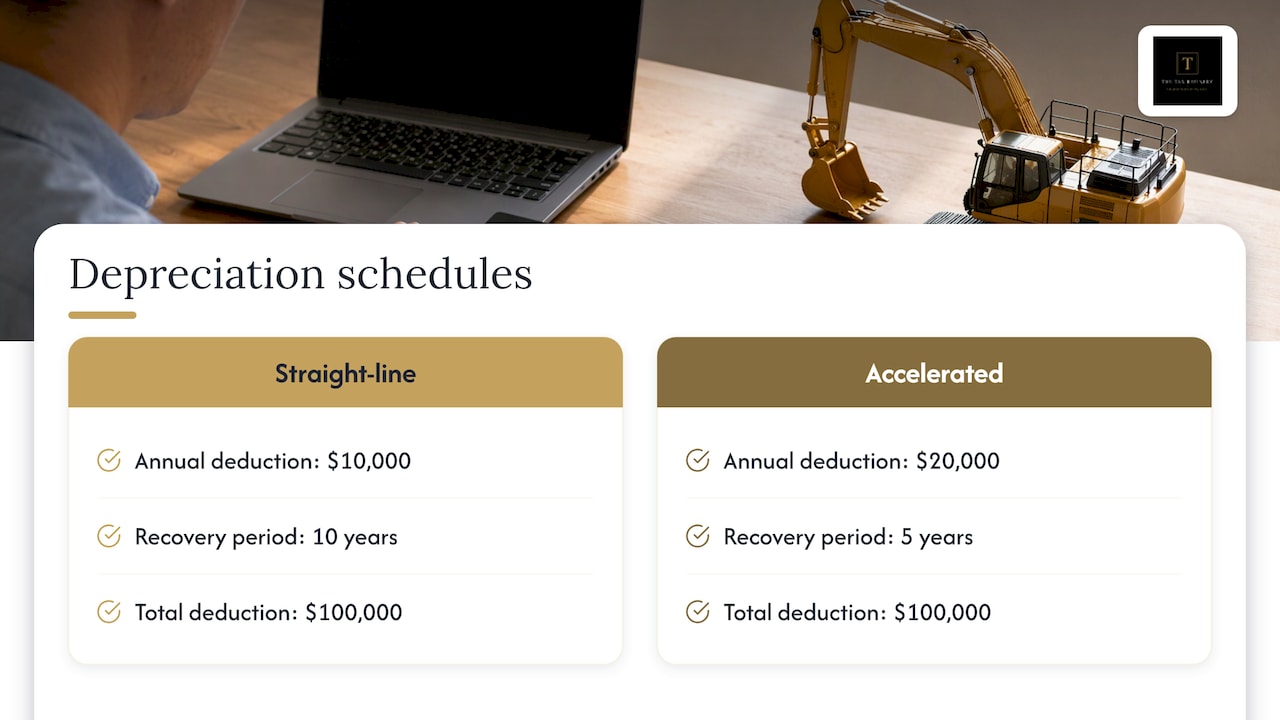
Cornell's legal encyclopedia describes accelerated depreciation as accounting for a greater share of an asset's lifetime value loss earlier in its life. Its example is a $100,000 tractor with a 10-year life: straight-line deducts $10,000 a year for 10 years, while an accelerated schedule deducts $20,000 a year for 5 years (Cornell LII, accelerated depreciation). The total is $100,000 either way.
Under the federal regulations, straight-line takes the cost or other basis of the property, subtracts estimated salvage value, and deducts the result in equal annual amounts over the estimated useful life (26 CFR 1.167(b)-1). Salvage value is what you expect the asset to be worth when you finish using it.
How each method is calculated
Straight-line
The formula is simple: (cost minus salvage value) divided by years of life. OpenStax's accounting text uses a $58,000 press with $10,000 salvage value and a five-year life. The depreciable base is $48,000, so straight-line gives $9,600 every year (OpenStax, Principles of Financial Accounting).
The IRS shows the same logic for intangible property. In Publication 946, a patent bought for $5,100 with a 17-year useful life and no salvage value produces a $300 annual deduction, prorated to $225 for the first nine months it is in use (IRS Publication 946).
Declining balance
The most common accelerated formula for books is double-declining balance. You double the straight-line rate and apply it to the asset's remaining book value each year. For the same press, the straight-line rate is 20% (100% divided by 5 years), the doubled rate is 40%, and year one is $58,000 × 40% = $23,200. Depreciation stops when book value hits the $10,000 salvage value, and the total is still $48,000 (OpenStax).
The Tax Policy Center gives a cleaner side-by-side. A $10,000 asset with a 10-year life and no residual value yields $1,000 a year under straight-line. Under 200% declining balance it yields $2,000 in year one and $1,600 in year two, and businesses typically switch to straight-line once its rate exceeds the declining balance rate (Tax Policy Center).
| Straight-line | Accelerated (200% declining balance) | |
|---|---|---|
| Year 1 deduction, $10,000 asset, 10-year life | $1,000 | $2,000 |
| Year 2 deduction | $1,000 | $1,600 |
| Pattern | Level every year | Largest early, tapering later |
| Total over the asset's life | Same | Same |
Where MACRS fits in
If you searched for MACRS vs straight-line, the key point is that they are not two separate worlds. MACRS, the Modified Accelerated Cost Recovery System, is the federal tax framework, and straight-line can be one of its options.
Publication 946 states that taxpayers must use MACRS to depreciate most property. The exceptions include property placed in service before 1987, intangible property, films and recordings, certain property acquired in nontaxable transfers, and property you elect out of MACRS (IRS Publication 946). Property placed in service after 1986 generally falls under MACRS (IRS Topic 704).
The 2025 Form 4562 instructions explain how it works. MACRS sorts assets into classes that set the recovery period, and each class has a predetermined schedule of annual percentages. MACRS has two systems, the General Depreciation System (GDS) and the Alternative Depreciation System (ADS). You can make an irrevocable election to use straight-line for all property in a class placed in service during the tax year. For 3-, 5-, 7- or 10-year property, you can also elect 150% declining balance instead of 200% (2025 Instructions for Form 4562).
So for tax purposes, the real question is rarely accelerated or straight-line in the abstract. It is which MACRS treatment to use, whether to claim bonus depreciation on top, and whether a straight-line election ever serves you better.
A MACRS schedule in practice
The IRS Depreciation FAQs walk through a $15,000 used pickup in the five-year class, placed in service in March. The deductions run $3,000 (20.00%), $4,800 (32.00%), $2,880 (19.20%), $2,880 (11.52%), $2,880 (11.52%) and $864 (5.76%), totaling $15,000 (IRS Depreciation FAQs). Notice that the first year is only 20%, not 40%. That is the half-year convention: MACRS assumes personal property goes into service mid-year.
There is a trap here. The same IRS FAQs explain that the mid-quarter convention applies when more than 40% of your newly purchased personal property is placed in service in the last three months of the year (IRS Depreciation FAQs). A large December equipment purchase can therefore shrink your first-year percentage across all of that year's purchases. Timing of placed-in-service dates matters as much as the method.
Bonus depreciation: the most accelerated option
Bonus depreciation, formally the additional first-year depreciation deduction under section 168(k), is the fastest form of acceleration. It lets you deduct a large share of qualified property's cost in the first year.
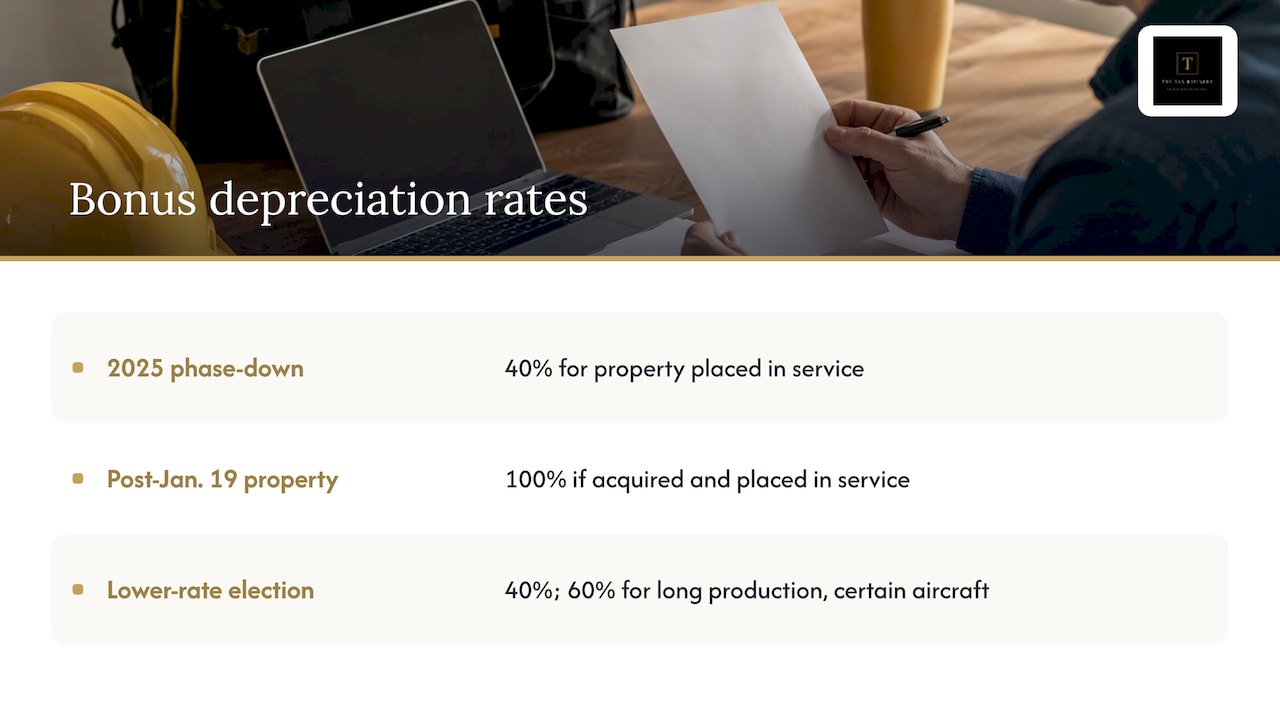
The rules changed recently. IRS Notice 2026-11 explains that the bonus rate had been phasing down, to 40% for property placed in service in 2025. The One Big Beautiful Bill Act (OBBBA) removed the phase-down and the January 1, 2027 deadline. It provides a permanent 100% additional first-year deduction for qualified property acquired and placed in service after January 19, 2025, with an election to take the lower 40% rate (60% for long production period property and certain aircraft) in the first tax year ending after that date (IRS Notice 2026-11). Publication 946 for 2025 also notes that qualified production property placed in service after July 4, 2025, with construction beginning or acquisition after January 19, 2025, is eligible for a 100% allowance (IRS Publication 946).
For a deeper look at how the 100% rules work, see our guide to bonus depreciation in 2026. If you are weighing it against expensing, our comparison of Section 179 vs. bonus depreciation covers the choice.
Why faster usually wins at your income level
Cornell explains the logic: because of the time value of money, a business pays less in total tax by taking bigger deductions now in exchange for smaller ones later (Cornell LII). A dollar of tax saved this year can be reinvested this year. Penn State's depreciation course material makes the same point: shifting deductions toward the early years gives the owner a lower tax burden earlier and higher profits in the years right after the investment (Penn State, Depreciation Accounting).
Here is a hypothetical to show the scale. Say your S corporation buys $200,000 of qualifying equipment and your owners are in a combined 35% bracket.
| Straight-line over 5 years | 100% bonus depreciation | |
|---|---|---|
| Year 1 deduction | $40,000 | $200,000 |
| Year 1 tax reduction at 35% | $14,000 | $70,000 |
| Years 2 to 5 | $40,000 a year | $0 |
| Total deduction | $200,000 | $200,000 |
The figures are illustrative arithmetic, not a forecast, and the straight-line column ignores the half-year convention for simplicity. The point stands: the total deduction is identical, but the year-one cash difference is $56,000 in this example.
When a slower schedule can make sense
Acceleration is not automatically best in every year. A deduction is worth the most when it lands against income taxed at a high rate. Planning therefore means looking across years and across entities:
- A lower-income year ahead. If this year's income is unusually high and next year's will be lower, taking the deduction now is typically the stronger move. If the pattern is reversed, spreading deductions forward can match them to the higher-income years.
- Multiple entities. When you own several businesses, the deduction lands on the entity that owns the asset, which flows to your return through the ownership structure. Where you hold equipment, vehicles or property affects how much of the deduction you can use.
- Irrevocable elections. The straight-line election covers a whole class of property for the year and cannot be reversed (Form 4562 instructions), so it should be a planned choice.
- Books versus tax. Financial statements and tax returns can use different methods. Accounting history shows this split has existed since 1954, when the tax code allowed accelerated methods without requiring the books to match (Rice University accounting history paper). If a lender sees your books, the book method affects reported profit. Allocating a cost over time on the books follows the same logic as other capitalized costs, such as the ones in this capitalized software cost analysis.
What this means by reader type
Owners netting $300,000 to $1,000,000. Equipment, vehicles and build-outs are where accelerated methods pay off. Whether an improvement qualifies for faster recovery depends on its category. Our guides on qualified improvement property and land improvements cover two common ones.
Real estate investors. Buildings are generally recovered over long straight-line schedules, so the acceleration opportunity sits in components and improvements that fall into shorter classes. Short-term rentals have their own rules, which we cover in our article on bonus depreciation for short-term rentals.
S-corp and multi-entity owners. Depreciation reduces the income that passes through to you, which interacts with your salary and distribution planning. Because the entity that owns the asset matters, depreciation belongs in the entity conversation, not only on the return.
High-earning W-2 employees and nurse practitioners. Depreciation helps when you own something that earns income: a side practice, rental property or a business entity. If you are an employee with no business assets, there is nothing to depreciate on your own return.
Already used the wrong method? An incorrect method can often be corrected by changing the accounting method, which is how the Form 3115 process works. Our guide to the Section 481(a) adjustment explains the catch-up mechanics.
A practical way to decide
- List what you bought or will buy. Note the cost, the date it will be placed in service and the asset class.
- Project income for this year and the next two or three. The deduction should land where the tax rate is highest.
- Check which entity owns each asset. Make sure the deduction reaches the return that can use it.
- Compare three treatments. Run standard MACRS, bonus depreciation and a straight-line or 150% election, and compare total tax across years, not only year one.
- Watch the calendar. A late-year purchase can trigger the mid-quarter convention.
- Document it. Keep invoices, in-service dates and the method elected, so the return holds up.
Where we come in
Running those comparisons across multiple entities and years is the kind of work our year-round tax strategy is built around. For owners who want depreciation planned before purchases are made, we offer Quarterly Tax Strategy Sessions at $9,497 per year and Monthly Tax Advisory at $11,997 per year. If you own an S corporation and want the structure right first, the S-Corp Tax Strategy Accelerator is $997.

If you only need a return prepared, our published form-based fees include $1,800 for Form 1120-S and Form 1065 and $550 for an investor or rental owner return.
Our perspective
Most owners we talk with think of depreciation as something their preparer calculates in March. We think of it as a decision you make before you sign the purchase order.
The method is only one lever. The entity that owns the asset, the year it is placed in service and your income in the years around it all change what a deduction is worth. A schedule chosen after the fact leaves that value on the table.
That is why our engagements are built around year-round strategy rather than a once-a-year filing. Our approach is to design the plan, build in the implementation, and keep the documentation so it stands up. Strategy should pay you back.
Melissa
FAQ
Is MACRS the same as accelerated depreciation?
MACRS is the federal tax system, and its default schedules are accelerated. Each asset class has predetermined annual percentages that front-load deductions (Form 4562 instructions). You can still elect straight-line within MACRS for a class of property placed in service that year.
Does accelerated depreciation increase my total deductions?
No. The total deduction over the asset's life is the same under either method, as the $58,000 press and $100,000 tractor examples both show. What changes is timing, and earlier deductions are worth more because of the time value of money.
Is the 100% bonus depreciation permanent now?
Under OBBBA, the 100% additional first-year deduction applies to qualified property acquired and placed in service after January 19, 2025, and the earlier phase-down and 2027 deadline were removed (IRS Notice 2026-11). You can elect a lower rate in the first applicable tax year. Whether a specific asset qualifies should be confirmed before you buy.
Can I switch methods after I file?
Some elections are irrevocable, such as straight-line for a whole property class. Other method errors can be corrected through a change in accounting method. Bring the question to a tax professional before amending anything.
Sources
- Cornell LII, accelerated depreciation
- 26 CFR 1.167(b)-1, straight line method
- OpenStax, Principles of Financial Accounting, depreciation methods
- IRS Publication 946
- Tax Policy Center, cost recovery for capital assets
- IRS Topic 704, Depreciation
- 2025 Instructions for Form 4562
- IRS Depreciation FAQs
- IRS Notice 2026-11
- Penn State, Depreciation Accounting
- Rice University, Impact of the Tax Law on GAAP